
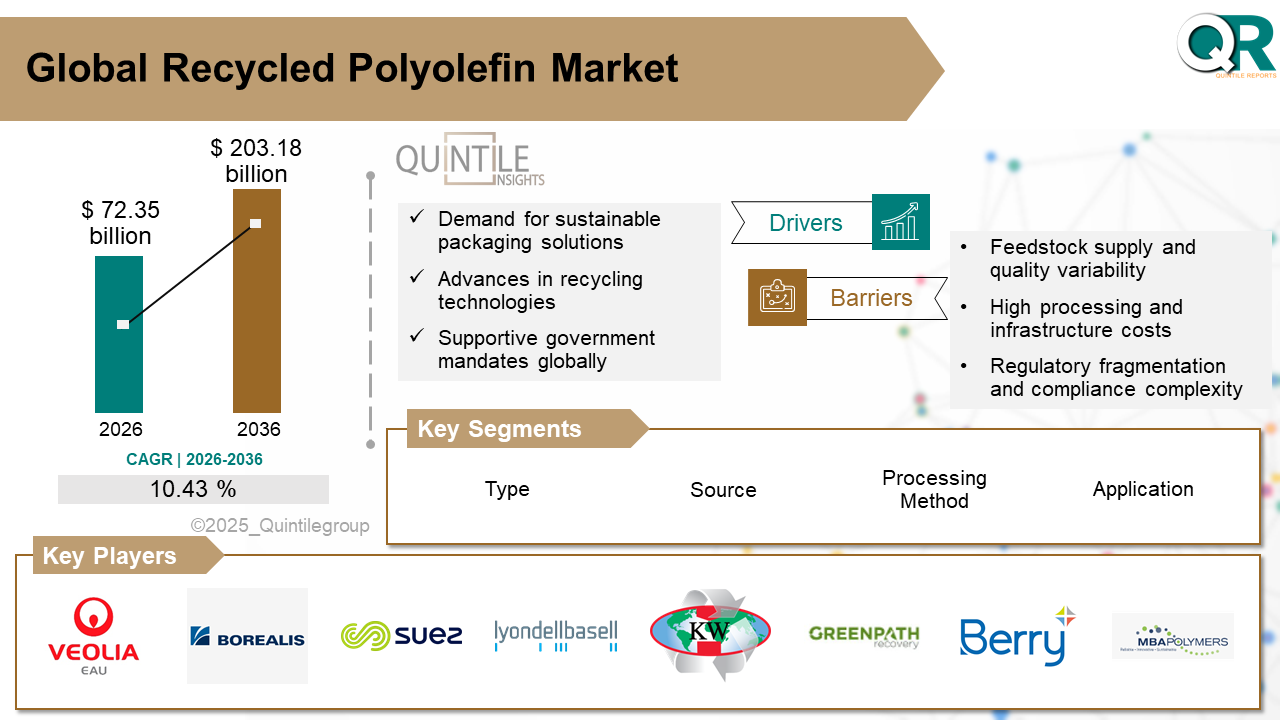
Recycled Polyolefin Market Growth, Trends, and Future Outlook (2026–2035)

Introduction

The Recycled Polyolefin Market is witnessing strong global growth as industries shift toward sustainable materials and circular economy practices. Polyolefins such as polyethylene (PE) and polypropylene (PP) are among the most widely used plastics in packaging, automotive, construction, and consumer goods. Recycling these materials plays a crucial role in reducing plastic waste and lowering environmental impact.

Driven by increasing environmental regulations, corporate sustainability goals, and rising consumer awareness, the recycled polyolefin industry is becoming a key segment of the global plastics market.

The market is expected to experience significant expansion during the forecast period, supported by advancements in recycling technologies and growing demand for eco-friendly materials.

Download Free Sample PDF of the Report https://www.quintilereports.com/request-sample/1290-recycled-polyolefin-market/

What is Recycled Polyolefin?

Recycled polyolefin refers to plastics recovered from post-consumer and post-industrial waste that are reprocessed into usable raw materials. These materials primarily include:

  • Recycled Polyethylene (rPE)
  • Recycled Polypropylene (rPP)

They are widely used in manufacturing new products such as:

  • Packaging materials
  • Automotive components
  • Construction products
  • Household goods
  • Industrial containers

Recycling polyolefins helps reduce landfill waste and supports sustainable manufacturing practices.

Recycled Polyolefin Market Overview

The market is expanding rapidly due to increasing global focus on sustainability and strict government regulations on plastic waste management.

Key growth drivers include:

  • Rising demand for sustainable packaging
  • Government bans on single-use plastics
  • Growth of circular economy initiatives
  • Technological advancements in recycling processes
  • Corporate ESG commitments

Industries are increasingly adopting recycled polyolefins as a cost-effective and environmentally responsible alternative to virgin plastics.

Market Growth Drivers

1. Rising Environmental Regulations

Governments across Europe, North America, and Asia-Pacific are implementing strict regulations to reduce plastic waste and promote recycling. These policies are accelerating the adoption of recycled polyolefins.

2. Growing Demand for Sustainable Packaging

The packaging industry is one of the largest consumers of polyolefins. Brands are shifting toward recyclable and eco-friendly packaging materials to meet consumer expectations.

3. Expansion of Circular Economy Models

The circular economy promotes reuse, recycling, and waste reduction. Recycled polyolefins are a key component in achieving these sustainability goals.

4. Technological Advancements in Recycling

Innovations in sorting, washing, and chemical recycling technologies have improved the quality and efficiency of recycled polyolefins.

5. Corporate Sustainability Initiatives

Companies are increasingly adopting ESG (Environmental, Social, and Governance) strategies, driving demand for recycled raw materials.

LinkedIn Article : https://www.linkedin.com/pulse/recycled-polyolefin-market-forecast-2036-driving-future-kirti-narayan-fwz6c

Market Challenges

Despite strong growth, the market faces several challenges:

  • Contamination in plastic waste streams
  • Inconsistent quality of recycled materials
  • High processing costs
  • Limited recycling infrastructure in developing regions
  • Supply chain inefficiencies

Market Segmentation

By Type

  • Recycled Polyethylene (rPE)
  • Recycled Polypropylene (rPP)

By Source

  • Post-Consumer Waste
  • Post-Industrial Waste

By Application

  • Packaging
  • Automotive
  • Construction
  • Consumer Goods
  • Textiles
  • Electrical & Electronics

Regional Analysis

North America

North America shows strong growth due to advanced recycling infrastructure and increasing corporate sustainability commitments.

Europe

Europe leads the global market with strict environmental regulations and strong circular economy policies.

Asia-Pacific

Asia-Pacific is the fastest-growing region due to rapid industrialization, urbanization, and increasing waste management initiatives in countries like China and India.

Middle East & Africa

The region is gradually adopting recycling technologies, supported by government initiatives and growing environmental awareness.

Competitive Landscape

The Recycled Polyolefin Market is highly competitive, with companies focusing on capacity expansion, innovation, and strategic partnerships.

Key players include:

  • Dow Inc.
  • LyondellBasell Industries
  • Borealis AG
  • SABIC
  • BASF SE
  • Veolia
  • Indorama Ventures

Companies are investing in:

  • Advanced mechanical recycling technologies
  • Chemical recycling solutions
  • Sustainable product development
  • Strategic mergers and acquisitions

Latest Blog : https://www.researcheditorial.com/news/industrial-drone-inspection-market/

Key Market Trends

Growth of Chemical Recycling

Chemical recycling is emerging as a key technology for processing contaminated plastic waste into high-quality raw materials.

Increasing Demand from Packaging Industry

Packaging remains the largest application segment due to strong demand for sustainable alternatives.

Rise of Circular Economy Practices

Companies are designing products with recyclability in mind, boosting demand for recycled polyolefins.

Expansion of Recycling Infrastructure

Governments and private players are investing in large-scale recycling facilities globally.

Future Outlook (2026–2035)

The future of the Recycled Polyolefin Market is strongly linked to sustainability and circular economy growth.

Key future developments include:

  • Wider adoption of chemical recycling
  • Increased use of recycled plastics in premium applications
  • Strong regulatory enforcement on plastic waste
  • Growth of closed-loop recycling systems
  • Expansion of global recycling networks

Conclusion

The Recycled Polyolefin Market is set to play a critical role in the global shift toward sustainable materials. With rising environmental awareness, regulatory pressure, and technological advancements, recycled polyolefins are becoming an essential part of modern manufacturing.

Companies that invest in recycling technologies and sustainable supply chains today will gain a strong competitive advantage in the future.

Frequently Asked Questions (Q&A)

Q1. What is the Recycled Polyolefin Market?

The Recycled Polyolefin Market refers to the production and use of recycled polyethylene (rPE) and polypropylene (rPP) derived from post-consumer and post-industrial plastic waste. These materials are reused in packaging, automotive, construction, and other industries.

Q2. What are the key drivers of the recycled polyolefin market?

The market is mainly driven by increasing environmental regulations, rising demand for sustainable packaging, growth in circular economy practices, technological advancements in recycling, and strong corporate sustainability goals.

Q3. Which industries use recycled polyolefins the most?

Major industries include packaging, automotive, construction, consumer goods, textiles, and electrical & electronics, where recycled plastics are used as a sustainable alternative to virgin materials.

Q4. What are the benefits of recycled polyolefins?

Recycled polyolefins help reduce plastic waste, lower carbon emissions, support sustainability goals, and provide a cost-effective alternative to virgin plastics in many applications.

Q5. What challenges does the recycled polyolefin market face?

Key challenges include contamination in waste streams, inconsistent material quality, limited recycling infrastructure, and high processing costs in some regions.

Q6. Which region leads the recycled polyolefin market?

Europe currently leads the market due to strict environmental regulations and strong circular economy initiatives, while Asia-Pacific is the fastest-growing region.

Q7. What is the future outlook of the recycled polyolefin market?

The market is expected to grow significantly due to increasing adoption of chemical recycling, expansion of circular economy systems, and rising demand for sustainable materials across industries.
Global PET Packaging Industry Outlook: Market Trends, Growth Drivers & Forecast to 2035

Introduction

The global PET Containers Market is entering a strong growth phase, supported by rising demand for sustainable packaging solutions, lightweight materials, and recyclable plastics. The market is expected to expand significantly over the next decade, driven by increasing consumption across the food & beverage, pharmaceutical, and personal care industries.

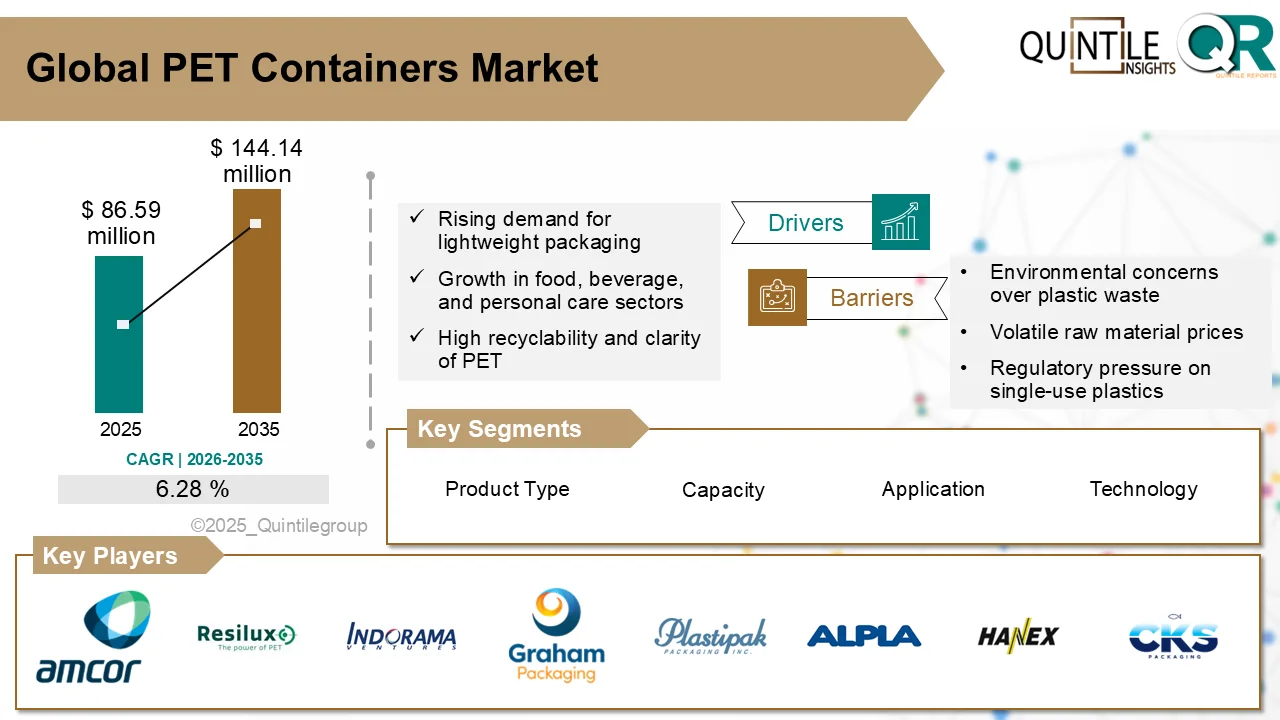
Valued at USD 86.59 million in 2025, the market is projected to reach USD 144.14 million by 2035, growing at a CAGR of 6.28% during 2026–2035.

Download Free Sample PDF of the Report : https://www.quintilereports.com/request-sample/1279-pet-containers-market/

Overview of PET Containers

PET (Polyethylene Terephthalate) containers are widely used plastic packaging solutions known for their durability, transparency, and recyclability. They are a preferred alternative to glass and metal due to their lightweight nature and cost efficiency.

Key Applications

  • Bottled water and beverages
  • Food storage and packaging
  • Pharmaceutical bottles and containers
  • Personal care and cosmetic packaging
  • Household chemical products

PET packaging plays a critical role in the global shift toward a circular economy and sustainable packaging systems.

Market Growth Outlook (2026–2035)

The PET Containers Market is expected to witness steady expansion driven by growing demand for eco-friendly packaging solutions and rising global FMCG consumption.

  • Market Value (2025): USD 86.59 Million
  • Forecast Value (2035): USD 144.14 Million
  • CAGR: 6.28%

Growth is strongly influenced by advancements in recycled PET (rPET) technologies and increasing government support for sustainable materials.

Latest Blog : https://www.researcheditorial.com/news/surveillance-drone-market/

Key Growth Drivers

1. Shift Toward Sustainable Packaging

Environmental concerns are pushing industries toward recyclable and low-impact packaging materials, with PET being a leading solution.

2. Expansion of Food & Beverage Consumption

Rising demand for packaged beverages, snacks, and ready-to-eat food products is boosting PET container usage globally.

3. Cost Efficiency & Logistics Benefits

PET containers reduce transportation costs due to their lightweight structure, improving supply chain efficiency.

4. Rising Urban Population

Urbanization and fast-paced lifestyles are increasing demand for convenient and portable packaging solutions.

Challenges in the Market

Despite strong growth, the industry faces several challenges:

  • Strict regulations on plastic usage
  • Environmental concerns over plastic waste
  • Raw material price fluctuations

However, innovation in recycling technologies and bio-based PET alternatives is helping reduce these barriers.

Emerging Market Trends

1. Rapid Adoption of Recycled PET (rPET)

Manufacturers are increasingly integrating rPET into production lines to meet sustainability goals.

2. Advanced Packaging Innovation

Focus is shifting toward lightweight, durable, and smart packaging designs.

3. Growth of E-commerce Packaging Demand

Online retail expansion is increasing demand for secure and impact-resistant packaging solutions.

4. Sustainable Manufacturing Practices

Companies are adopting energy-efficient and low-emission production processes.

LinkedIn Article : https://www.linkedin.com/pulse/pet-containers-market-size-growth-forecast-2035-key-trends-narayan-rivzc

Regional Insights

Asia-Pacific

Fastest-growing region due to industrial expansion, population growth, and rising FMCG demand.

North America

Driven by strong demand for sustainable packaging and advanced recycling systems.

Europe

Leader in circular economy adoption and strict environmental regulations.

Rest of the World

Emerging demand across Latin America, Middle East, and Africa presents new opportunities.

Competitive Landscape

The global PET Containers Market is highly competitive, with companies focusing on:

  • Sustainable packaging innovation
  • Expansion into emerging markets
  • Strategic partnerships and acquisitions
  • Investment in recycling infrastructure

Key Players Include:

  • General Atomics
  • Boeing
  • Parrot Drones SAS
  • AeroVironment Inc.
  • FLIR Systems Inc.

Key Reasons to Acquire This Market Report

Comprehensive Market Analysis (2017–2035)

This report provides detailed insights into market trends, segmentation, revenue forecasts, and regional dynamics across the global PET Containers Market.

Growth Drivers & Strategic Insights

It highlights key factors such as sustainability trends, FMCG expansion, rPET adoption, and regulatory developments, along with major challenges impacting the industry.

Competitive Intelligence & Market Structure

Understand market competition, supplier dynamics, buyer behavior, and substitution threats such as glass and aluminum packaging.

Detailed Market Segmentation

  • PET bottles
  • PET jars
  • Clamshell containers
  • Specialty PET packaging

End-use industries:

  • Food & beverages
  • Pharmaceuticals
  • Personal care
  • Household products
  • Industrial packaging

Future Outlook

The PET Containers Market is expected to maintain strong growth momentum through 2035, driven by increasing demand for sustainable, recyclable, and cost-effective packaging solutions. The expansion of rPET technologies and circular economy initiatives will further strengthen long-term market development.

Conclusion

The global PET Containers Market is positioned for steady expansion, supported by sustainability trends, rising FMCG demand, and innovation in packaging technologies. With strong growth prospects through 2035, the industry offers significant opportunities for manufacturers, investors, and stakeholders.

Frequently Asked Questions (FAQ)

Q1. What is the PET Containers Market?

The PET Containers Market refers to the global industry involved in the production and distribution of containers made from polyethylene terephthalate (PET). These containers are widely used in packaging beverages, food products, pharmaceuticals, and personal care items due to their lightweight, durable, and recyclable nature.

Q2. What is the market size of the PET Containers industry?

The global PET Containers Market was valued at USD 86.59 million in 2025 and is projected to reach USD 144.14 million by 2035, growing at a CAGR of 6.28% during 2026–2035.

Q3. What are the key drivers of the PET Containers Market?

Key drivers include:

  • Rising demand for sustainable packaging
  • Growth in the food & beverage industry
  • Increasing adoption of recycled PET (rPET)
  • Lightweight and cost-effective packaging solutions
  • Urbanization and changing consumer lifestyles

Q4. What industries use PET containers the most?

PET containers are widely used in:

  • Food & beverage industry (bottled water, soft drinks, packaged food)
  • Pharmaceutical industry (medicine bottles, syrup containers)
  • Personal care industry (cosmetics, shampoos)
  • Household and industrial chemical packaging

Q5. What are the major trends in the PET Containers Market?

Major trends include:

  • Growing use of recycled PET (rPET)
  • Innovation in lightweight and durable packaging
  • Expansion of e-commerce packaging demand
  • Shift toward sustainable and circular economy practices

Q6. Which region dominates the PET Containers Market?

Asia-Pacific dominates the market due to rapid industrialization, population growth, and high demand for packaged food and beverages. However, North America and Europe are strong markets driven by sustainability regulations and recycling initiatives.

Q7. Who are the key players in the PET Containers Market?

Major companies include:

  • Amcor plc
  • Berry Global Inc.
  • ALPLA Group
  • Plastipak Holdings, Inc.
  • Graham Packaging Company

Q8. What is the future outlook of the PET Containers Market?

The market is expected to grow steadily through 2035 due to increasing demand for eco-friendly packaging, advancements in recycling technologies, and rising global consumption of packaged goods.

Exit mobile version