
Introduction
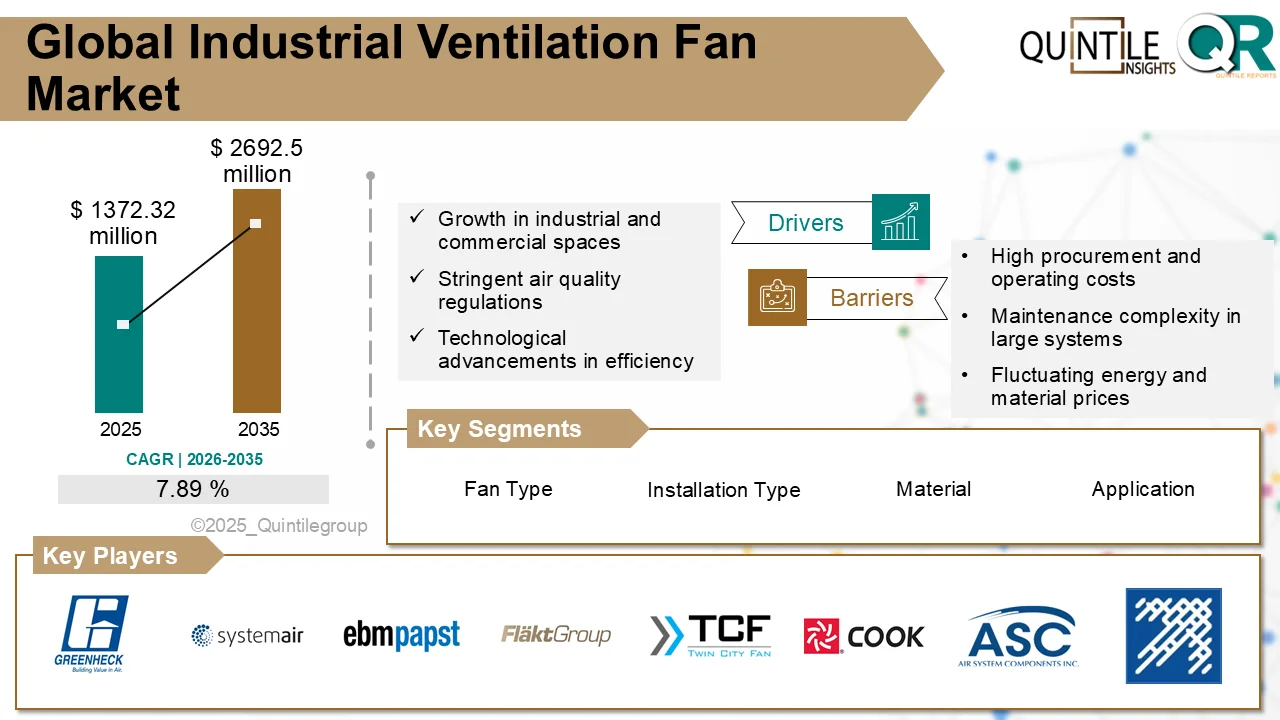
The Industrial Ventilation Fan Market plays a crucial role in maintaining safe, efficient, and productive industrial environments. These fans are widely used to regulate airflow, remove harmful fumes, control temperature, and ensure proper air circulation across manufacturing plants, warehouses, and processing facilities. With rapid industrialization and increasing emphasis on workplace safety and air quality, the demand for advanced ventilation solutions is witnessing significant growth worldwide.
Market Overview
Industrial ventilation fans are essential components in industries where heat, dust, smoke, or hazardous gases are generated. From heavy manufacturing to food processing and chemical plants, these systems help maintain compliance with environmental and occupational safety standards.
The market is experiencing steady expansion due to growing industrial infrastructure, particularly in emerging economies. Additionally, modernization of existing facilities and the adoption of energy-efficient systems are further supporting market growth.
Download Free Sample PDF of the Report https://www.quintilereports.com/request-sample/1274-industrial-ventilation-fan-market/
Key Market Drivers
1. Rising Industrialization
The expansion of manufacturing and processing industries across developing regions is a major driver for the Industrial Ventilation Fan Market. Increased production activities create a strong need for efficient ventilation systems.
2. Growing Focus on Workplace Safety
Strict regulations regarding employee health and safety are encouraging industries to install advanced ventilation systems. Proper airflow helps reduce exposure to harmful particles, fumes, and excessive heat.
3. Demand for Energy-Efficient Solutions
Industries are increasingly adopting energy-efficient ventilation fans to reduce operational costs and carbon emissions. Modern fans with advanced motor technologies and smart controls are gaining traction.
4. Expansion of HVAC Applications
The integration of industrial fans into HVAC systems is expanding their application scope, especially in large commercial and industrial facilities.
Market Restraints
High Installation and Maintenance Costs
The initial investment required for industrial ventilation systems can be high, especially for large-scale facilities, which may limit adoption among small and medium enterprises.
Energy Consumption Concerns
Despite advancements, some industrial fans still consume significant energy, impacting operational costs and sustainability goals.
Latest blog : https://www.researcheditorial.com/news/dioxin-analyzer-market/
Opportunities in the Market
Technological Advancements
Innovations such as IoT-enabled fans, automated control systems, and smart monitoring solutions are creating new growth opportunities.
Growth in Emerging Markets
Countries in Asia-Pacific, Latin America, and the Middle East are witnessing rapid industrial growth, offering lucrative opportunities for market players.
Retrofitting and Upgradation
Replacement of outdated ventilation systems with modern, energy-efficient solutions is expected to drive demand in developed regions.
Market Segmentation
By Product Type
- Axial Fans
- Centrifugal Fans
- Mixed-Flow Fans
- High-Volume Low-Speed (HVLS) Fans
By Application
- Air Circulation
- Exhaust & Ventilation
- Cooling Systems
- Dust & Fume Extraction
By End-Use Industry
- Manufacturing
- Power Generation
- Mining
- Chemicals
- Food & Beverage
- Commercial HVAC
LinkedIn article : https://www.linkedin.com/pulse/industrial-ventilation-fan-market-size-share-growth-forecast-narayan-cg7nc
Competitive Landscape
The Industrial Ventilation Fan Market is highly competitive, with both global and regional players striving to enhance their product portfolios. Companies are focusing on innovation, energy efficiency, and customization to meet diverse industrial requirements. Strategic partnerships, mergers, and acquisitions are also common to strengthen market presence.
Regional Insights
Asia-Pacific
Dominates the market due to rapid industrialization, urbanization, and infrastructure development in countries like China and India.
North America
Driven by stringent safety regulations and the adoption of advanced technologies in industrial facilities.
Europe
Focuses on energy-efficient and environmentally sustainable ventilation solutions.
Middle East & Africa and Latin America
Emerging markets with increasing investments in industrial and construction sectors.
Future Outlook
The Industrial Ventilation Fan Market is expected to witness robust growth through 2035, driven by technological advancements, regulatory compliance, and increasing industrial activities. The shift toward smart and energy-efficient systems will play a key role in shaping the future of the market.
Conclusion
The Industrial Ventilation Fan Market is evolving rapidly as industries prioritize safety, efficiency, and sustainability. With growing demand across multiple sectors and continuous technological innovation, the market presents significant opportunities for stakeholders. Businesses investing in advanced ventilation solutions will be better positioned to enhance productivity, ensure compliance, and achieve long-term growth.
Industrial Ventilation Fan Market – Frequently Asked Questions (FAQs)
Q1. What is the Industrial Ventilation Fan Market?
The Industrial Ventilation Fan Market refers to the global industry focused on the production, distribution, and application of ventilation fans used in industrial settings to regulate airflow, remove contaminants, and maintain safe working conditions.
Q2. What are the key types of industrial ventilation fans?
The main types include axial fans, centrifugal fans, mixed-flow fans, and high-volume low-speed (HVLS) fans, each designed for specific airflow and pressure requirements.
Q3. What factors are driving market growth?
Key drivers include rapid industrialization, increasing focus on workplace safety, stringent air quality regulations, and rising demand for energy-efficient ventilation systems.
Q4. Which industries use industrial ventilation fans the most?
Major end-use industries include manufacturing, mining, power generation, chemicals, food & beverage, and commercial HVAC systems.
Q5. What are the major challenges in the market?
High installation and maintenance costs, energy consumption concerns, and intense competition among manufacturers are some of the key challenges.
Q6. How is technology impacting the market?
Technological advancements such as IoT-enabled fans, smart monitoring systems, and energy-efficient motor designs are enhancing performance and driving innovation.
Q7. Which region dominates the Industrial Ventilation Fan Market?
Asia-Pacific leads the market due to rapid industrial growth, followed by North America and Europe.
Q8. What opportunities exist in this market?
Opportunities include expansion in emerging economies, retrofitting old systems, and increasing demand for smart and energy-efficient ventilation solutions.
Q9. What is the future outlook of the market?
The market is expected to grow steadily through 2035, supported by industrial expansion, regulatory compliance, and continuous technological advancements.
Q10. Why should businesses invest in industrial ventilation fans?
Investing in advanced ventilation systems improves air quality, enhances worker safety, boosts productivity, and ensures compliance with environmental and safety standards.