
Mechanical Power Transmission Market Overview
The global Mechanical Power Transmission Market is witnessing significant growth due to rising industrial automation, expanding manufacturing activities, increasing electric vehicle production, and rapid adoption of Industry 4.0 technologies.
Mechanical power transmission systems play a vital role in transferring energy from motors and engines to industrial machinery and equipment. These systems are widely used across industries such as automotive, manufacturing, mining, aerospace, agriculture, renewable energy, construction, and oil & gas.
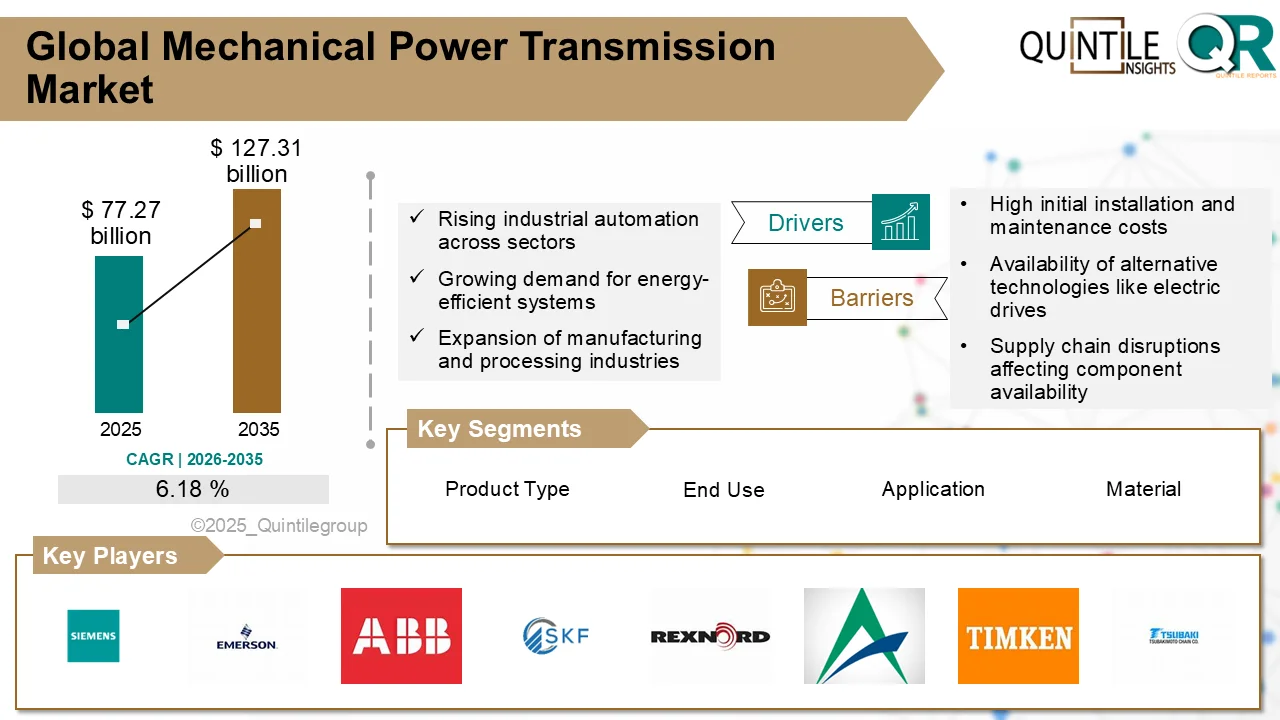
The market was valued at USD 77.27 billion in 2025 and is projected to reach USD 127.31 billion by 2035, growing at a CAGR of 6.18% during the forecast period.
The growing demand for energy-efficient machinery, smart factories, predictive maintenance technologies, and advanced industrial automation systems is accelerating market expansion globally.
Download Free Sample PDF of the Report https://www.quintilereports.com/request-sample/1267-mechanical-power-transmission-market/
What is Mechanical Power Transmission?
Mechanical power transmission refers to the process of transmitting power, motion, and torque from one machine component to another through mechanical systems.
Key mechanical transmission components include:
- Gear drives
- Belt drives
- Chain drives
- Bearings
- Couplings
- Clutches
- Brakes
- Pulleys
- Sprockets
- Shaft drives
These systems are essential for controlling machine movement, improving operational efficiency, and ensuring smooth industrial operations.
Mechanical power transmission technologies are widely adopted in:
- Industrial machinery
- Automotive systems
- Mining equipment
- Renewable energy infrastructure
- Robotics and automation systems
- Agricultural equipment
- Aerospace engineering
- Marine applications
Mechanical Power Transmission Market Dynamics
Market Drivers
Rising Adoption of Industry 4.0 and Smart Manufacturing
One of the primary growth drivers of the mechanical power transmission market is the increasing adoption of Industry 4.0 technologies.
Manufacturers are investing heavily in:
- Smart factories
- Automated production lines
- IoT-enabled machinery
- Predictive maintenance systems
- AI-based monitoring solutions
- Industrial robotics
Advanced mechanical transmission systems integrated with smart sensors and real-time monitoring technologies help industries improve operational efficiency and reduce downtime.
Latest Blog : https://www.researcheditorial.com/news/flexi-bag-market/
Growing Demand for Energy-Efficient Systems
Industries worldwide are focusing on reducing energy consumption and improving sustainability.
Energy-efficient mechanical transmission systems help:
- Minimize power loss
- Improve machine performance
- Reduce maintenance costs
- Lower operational expenses
- Support environmental goals
This trend is driving strong demand for lightweight and high-efficiency transmission components.
Expansion of Electric Vehicle Manufacturing
The rapid expansion of the electric vehicle industry is creating significant opportunities for the mechanical power transmission market.
EV manufacturers require:
- Precision gear systems
- Lightweight transmission components
- Advanced bearings
- High-performance drivetrain systems
Countries such as the United States, China, Germany, Japan, and India are witnessing increasing investments in EV manufacturing and smart mobility infrastructure.
Infrastructure and Industrial Development
Rapid urbanization and industrialization across emerging economies are accelerating demand for mechanical transmission systems.
Major infrastructure projects involving:
- Construction equipment
- Industrial plants
- Renewable energy facilities
- Transportation systems
- Mining operations
are driving the adoption of durable and high-performance power transmission technologies.
Market Restraints
High Initial Investment Costs
Advanced transmission systems integrated with smart technologies often require significant upfront investment.
Small and medium-sized enterprises may face budget constraints while adopting modern mechanical transmission solutions.
Competition from Electronic Drive Systems
Electronic and direct-drive systems are increasingly competing with traditional mechanical transmission technologies.
Industries are gradually adopting:
- Electric drives
- Servo systems
- Compact motor technologies
- Electronic transmission systems
This may limit growth opportunities for some conventional transmission products.
Emerging Trends in the Mechanical Power Transmission Market
Predictive Maintenance Technologies
Predictive maintenance is becoming a major trend in industrial operations.
IoT-enabled transmission systems can:
- Monitor machine performance
- Detect wear and vibration
- Predict equipment failure
- Reduce downtime
- Improve productivity
Industries are increasingly investing in AI-powered predictive maintenance solutions to enhance operational reliability.
Lightweight and Sustainable Materials
Manufacturers are focusing on lightweight materials such as:
- Aluminum alloys
- Composite materials
- High-strength steel
- Advanced polymers
These materials help improve energy efficiency and reduce overall machine weight.
Integration with Robotics and Automation
The growing use of robotics in manufacturing and industrial automation is boosting demand for high-precision transmission systems.
Modern robotic systems require:
- Smooth motion control
- Compact transmission components
- High torque efficiency
- Low-maintenance systems
This trend is expected to create strong growth opportunities through 2035.
Mechanical Power Transmission Market Segmentation
By Product Type
The market is segmented into:
- Couplings
- Clutches
- Brakes
- Gear Drives
- Belt Drives
- Chain Drives
- Shaft Drives
- Bearings
- Pulleys
- Sprockets
Gear drives and bearings remain among the most widely used components across industrial applications.
By Material
Based on material, the market includes:
- Steel
- Cast Iron
- Aluminum
- Composite Materials
- Others
Steel continues to dominate due to its durability, strength, and industrial reliability.
By Application
Applications covered in the market include:
- Conveyors
- Compressors
- Pumps
- Fans & Blowers
- Mixers & Agitators
- Crushers
Industrial automation and conveyor systems represent major growth segments.
By End-Use Industry
Key end-use industries include:
- Automotive
- Aerospace & Defense
- Mining
- Agriculture
- Manufacturing
- Oil & Gas
- Power Generation
- Construction
- Food & Beverage
- Marine
The automotive and manufacturing sectors account for a substantial market share.
LinkedIn Article : https://www.linkedin.com/pulse/mechanical-power-transmission-market-2026-industry-40-kirti-narayan-tbq5c
Regional Analysis
North America
North America is experiencing strong growth due to:
- Industrial automation
- Smart manufacturing investments
- EV production growth
- Renewable energy expansion
The United States remains a leading market for advanced industrial transmission technologies.
Europe
Europe is focusing heavily on:
- Sustainable manufacturing
- Energy-efficient systems
- Electric mobility
- Smart factory technologies
Germany continues to lead the region due to its strong industrial and automotive ecosystem.
Asia Pacific
Asia Pacific dominates the global market due to:
- Rapid industrialization
- Infrastructure development
- Manufacturing growth
- Renewable energy investments
China, India, Japan, and South Korea are key contributors to regional growth.
Latin America
The Latin American market is expanding steadily due to growth in:
- Mining operations
- Agricultural machinery
- Industrial manufacturing
- Construction activities
Brazil and Mexico are major regional markets.
Middle East & Africa
The Middle East & Africa region is witnessing increasing demand from:
- Oil & gas industries
- Renewable energy projects
- Infrastructure modernization
- Mining operations
Industrial diversification initiatives are supporting long-term market growth.
Competitive Landscape
The mechanical power transmission market is highly competitive.
Leading companies are focusing on:
- Product innovation
- AI-driven monitoring systems
- Smart transmission technologies
- Sustainable manufacturing
- Strategic partnerships
- Global expansion
Key players operating in the market include:
- Siemens AG
- ABB Ltd.
- Emerson Electric Co.
- SKF Group
- Timken Company
- Schaeffler Group
- Regal Rexnord Corporation
- Dana Incorporated
- Bonfiglioli Riduttori S.p.A
- Altra Industrial Motion Corp.
Companies investing in predictive maintenance and intelligent automation technologies are expected to strengthen their market position.
Future Outlook of the Mechanical Power Transmission Market
The future of the mechanical power transmission market looks highly promising due to increasing investments in:
- Smart manufacturing
- Industrial automation
- Electric vehicles
- Renewable energy infrastructure
- Robotics and AI
- Sustainable industrial technologies
Technological advancements, predictive maintenance systems, and IoT integration will continue transforming industrial operations globally.
Manufacturers focusing on innovation, energy efficiency, and digital transformation are expected to gain long-term competitive advantages.
Conclusion
The Mechanical Power Transmission Market is expected to witness strong growth through 2035, driven by Industry 4.0 adoption, industrial automation, electric vehicle manufacturing, and renewable energy expansion.
As industries continue modernizing operations and adopting intelligent manufacturing systems, demand for efficient and high-performance mechanical transmission technologies will continue rising.
Businesses investing in smart, sustainable, and digitally connected transmission systems are likely to lead the next phase of industrial transformation.
Frequently Asked Questions (FAQs)
What is the Mechanical Power Transmission Market?
The Mechanical Power Transmission Market includes systems and components used to transfer mechanical power and motion across industrial machinery and equipment.
What is driving the growth of the Mechanical Power Transmission Market?
Key growth drivers include industrial automation, Industry 4.0 adoption, EV manufacturing growth, renewable energy investments, and demand for energy-efficient machinery.
Which industries use mechanical power transmission systems?
Major industries include automotive, aerospace, manufacturing, mining, agriculture, renewable energy, construction, and oil & gas.
Which region dominates the Mechanical Power Transmission Market?
Asia Pacific currently dominates the global market due to rapid industrialization and manufacturing expansion.
What are the key trends shaping the market?
Key trends include predictive maintenance, IoT-enabled machinery, AI-based monitoring systems, lightweight materials, robotics integration, and smart manufacturing technologies.
About Quintile Reports
Quintile Reports provides comprehensive market research and business intelligence solutions across multiple industries worldwide.
Our reports deliver:
- Market forecasts
- Competitive analysis
- Industry trends
- Strategic insights
- Growth opportunities
- Regional intelligence
For customized market research solutions:
Email: sales@quintilereports.com
APAC: +91-626-560-6898
Website: https://www.quintilereports.com