
Industrial Drone Inspection Market Growth, Trends, and Future Outlook 2026–2035

Introduction

The Industrial Drone Inspection Market is undergoing a major transformation as industries shift toward automation, safety, and data-driven operations. Traditional inspection methods involving manual labor, scaffolding, and heavy equipment are rapidly being replaced by unmanned aerial vehicles (UAVs) equipped with advanced sensors and AI capabilities.

The global market is experiencing strong growth, driven by rising demand for efficient asset monitoring across oil & gas, energy, construction, mining, and infrastructure sectors.

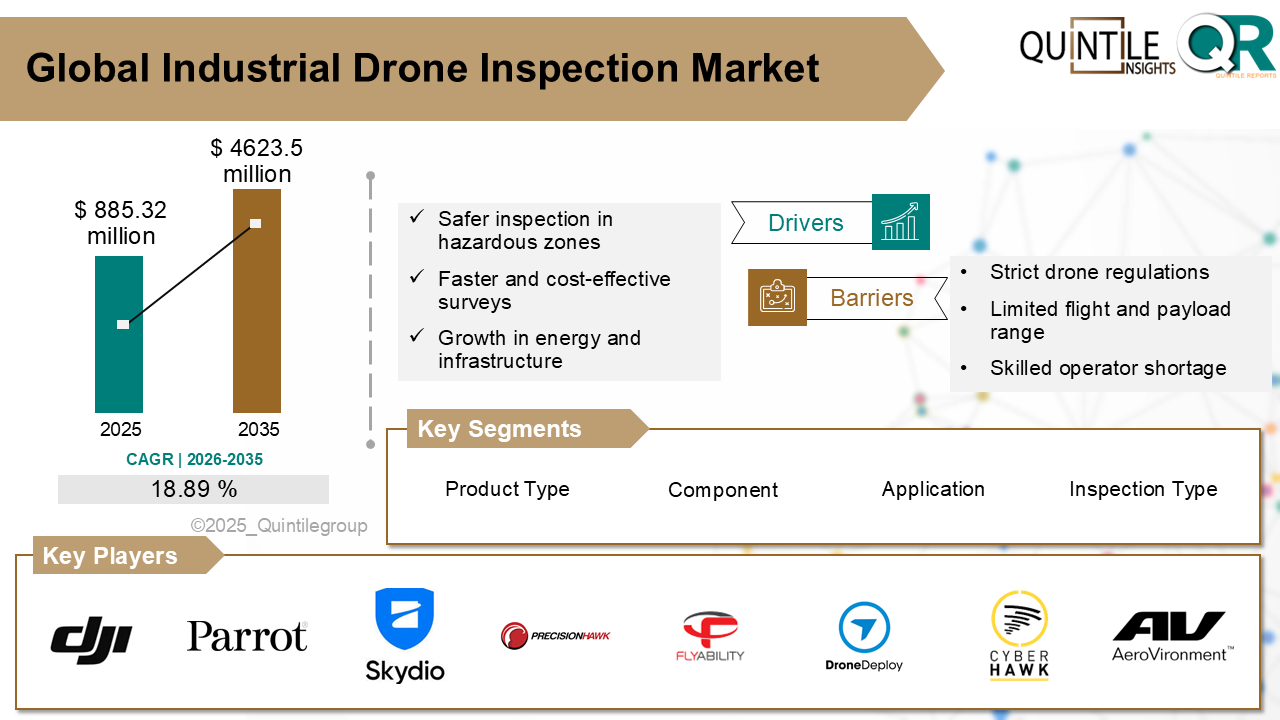
According to industry estimates, the market was valued at USD 885.32 million in 2025 and is expected to reach USD 4.62 billion by 2035, growing at a CAGR of 18.89% (2026–2035).

Download Free Sample PDF of the Report https://www.quintilereports.com/request-sample/1265-industrial-drone-inspection-market/

What is Industrial Drone Inspection?

Industrial drone inspection refers to the use of drones equipped with cameras, LiDAR, thermal imaging, and multispectral sensors to inspect industrial assets and infrastructure.

These drones are widely used for:

  • Pipeline inspection
  • Power line monitoring
  • Wind turbine inspection
  • Solar farm assessment
  • Construction site mapping
  • Mining site surveillance
  • Oil & gas facility inspection

By replacing manual inspection methods, drones enable safer, faster, and more accurate data collection.

Industrial Drone Inspection Market Overview

The market is evolving due to rapid advancements in drone technology and increasing adoption of smart infrastructure solutions.

Industries are increasingly investing in drone-based inspection systems to improve operational efficiency and reduce risks associated with manual inspections.

Key benefits include:

  • Reduced operational costs
  • Faster inspection cycles
  • Improved safety standards
  • Real-time data collection
  • Predictive maintenance capabilities

LinkedIn article : https://www.linkedin.com/pulse/industrial-drone-inspection-market-future-smart-20262035-narayan-6yazc

Market Growth Drivers

1. Rising Safety Concerns

Industrial environments such as oil rigs, power plants, and mining sites are hazardous. Drone inspections eliminate the need for human exposure to dangerous conditions, reducing workplace accidents significantly.

2. Cost Efficiency

Drone inspections reduce dependency on heavy equipment, cranes, and labor-intensive processes. This leads to:

  • Lower maintenance costs
  • Reduced downtime
  • Faster project completion

3. Technological Advancements

Modern drones are equipped with:

  • AI-powered analytics
  • Thermal imaging sensors
  • LiDAR mapping systems
  • High-resolution cameras

These technologies enable precise defect detection and predictive maintenance.

4. Growing Digital Transformation

Industries are adopting Industry 4.0 technologies, including automation, IoT, and AI. Drone inspection fits seamlessly into this digital ecosystem.

5. Regulatory Support

Governments across major economies are introducing drone-friendly regulations, enabling commercial UAV operations in industrial sectors.

Market Challenges

Despite strong growth, the market faces several challenges:

  • Strict and varying drone regulations across countries
  • Shortage of skilled drone operators
  • Weather-related operational limitations
  • Cybersecurity risks in data transmission
  • High initial investment costs

Market Segmentation

By Drone Type

  • Fixed-Wing Drones
  • Rotary-Wing Drones
  • Hybrid Drones

By Component

  • Hardware
  • Software
  • Services

By Operation Mode

  • Remotely Operated
  • Semi-Autonomous
  • Fully Autonomous

By Inspection Type

  • Visual Inspection
  • Thermal Inspection
  • LiDAR Inspection
  • Multispectral Inspection
  • Infrared Inspection

By End-Use Industry

  • Energy & Utilities
  • Oil & Gas
  • Construction
  • Mining
  • Agriculture
  • Transportation
  • Telecommunications

Latest Blog : https://www.researcheditorial.com/news/last-mile-drone-delivery-market/

Regional Analysis

North America

North America leads the market due to strong infrastructure, advanced technology adoption, and supportive regulatory frameworks.

Europe

Europe focuses on safety, sustainability, and Industry 4.0 integration. Countries like Germany, the UK, and France are major adopters.

Asia-Pacific

Asia-Pacific is the fastest-growing region, driven by rapid industrialization, infrastructure development, and government investments in automation technologies.

Middle East & Africa

Growth is supported by oil & gas industries, smart city projects, and large-scale infrastructure development in UAE and Saudi Arabia.

Competitive Landscape

The Industrial Drone Inspection Market is highly competitive, with key players focusing on innovation, AI integration, and service expansion.

Key companies include:

  • DJI
  • Parrot SA
  • Skydio
  • AeroVironment
  • Flyability
  • DroneDeploy
  • PrecisionHawk

Companies are focusing on:

  • AI-powered inspection analytics
  • Fully autonomous drone systems
  • End-to-end inspection solutions
  • Subscription-based drone services

Key Market Trends

AI-Powered Predictive Maintenance

Drones are increasingly used for predictive analytics to identify faults before failures occur.

Autonomous Drone Operations

Fully autonomous drones are reducing the need for human intervention.

Digital Twin Integration

Inspection data is used to create digital models of infrastructure for real-time monitoring.

Drone-as-a-Service (DaaS)

Companies are shifting toward service-based drone inspection models instead of hardware ownership.

Future Outlook (2026–2035)

The future of industrial drone inspection lies in:

  • Full automation
  • AI-driven analytics
  • Integration with IoT and digital twins
  • Expansion in emerging economies
  • Smarter, longer-range drones

The market will continue evolving into a data intelligence ecosystem, rather than just a hardware-based industry.

Conclusion

The Industrial Drone Inspection Market is reshaping how industries inspect, monitor, and maintain critical infrastructure. With rapid technological advancements and strong market demand, drones are becoming essential tools for safety, efficiency, and predictive maintenance.

Companies that adopt drone-based inspection early will gain a strong competitive advantage in cost reduction, operational efficiency, and asset reliability.
Last Mile Drone Delivery Market Size, Share, Growth Trends and Forecast 2035

Last Mile Drone Delivery Market Overview

The global Last Mile Drone Delivery Market is rapidly transforming the future of logistics and transportation. As e-commerce platforms, healthcare providers, and logistics companies continue searching for faster, more efficient, and cost-effective delivery systems, drone delivery technology is becoming a major innovation across the global supply chain industry.

Last mile delivery represents the final stage of the delivery process where goods are transported from a warehouse, fulfillment center, or distribution hub directly to the customer. Traditionally, this stage has been one of the most expensive and time-consuming parts of logistics operations. However, autonomous drones are now helping businesses overcome delivery delays, urban traffic congestion, rising labor costs, and growing consumer expectations for same-day delivery.

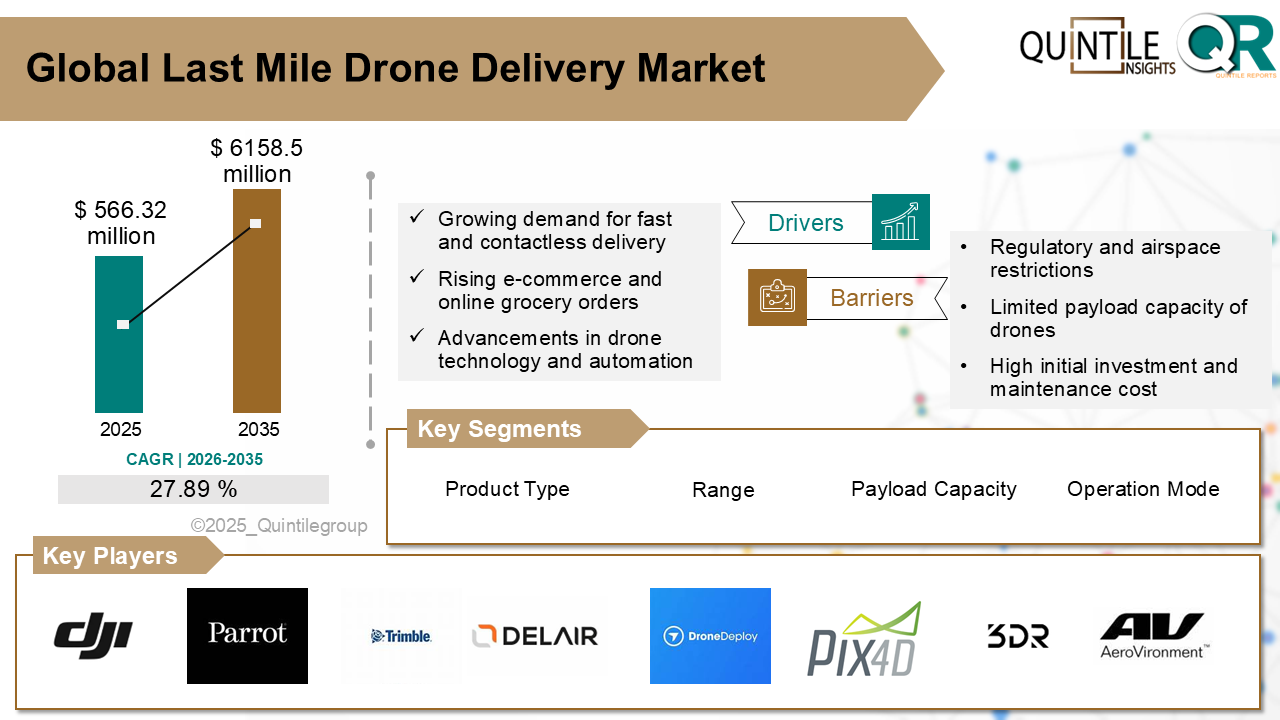
The Last Mile Drone Delivery Market was valued at USD 566.32 million in 2025 and is projected to reach USD 6158.5 million by 2035, growing at a CAGR of 27.89% during the forecast period.

Download Free Sample PDF of the Report https://www.quintilereports.com/request-sample/1266-last-mile-drone-delivery-market/

What Is Last Mile Drone Delivery?

Last mile drone delivery refers to the use of unmanned aerial vehicles (UAVs) to transport packages directly to customers. These drones operate autonomously or semi-autonomously using advanced technologies such as artificial intelligence, machine learning, GPS navigation, obstacle detection systems, and real-time analytics.

Drone delivery systems are increasingly used across multiple sectors including:

  • Retail and e-commerce
  • Healthcare and medical supply delivery
  • Food delivery services
  • Postal and parcel transportation
  • Industrial logistics
  • Emergency response operations

The growing adoption of drone delivery is helping businesses reduce operational costs, improve delivery speed, and achieve sustainability goals.

Key Drivers of the Last Mile Drone Delivery Market

Rapid Expansion of E-Commerce Industry

The explosive growth of online shopping is one of the major factors driving the Last Mile Drone Delivery Market. Consumers now expect faster deliveries with minimal delays. E-commerce companies are investing heavily in autonomous drone technology to improve customer satisfaction and streamline logistics operations.

Drone delivery helps companies:

  • Reduce delivery time
  • Improve operational efficiency
  • Lower fuel and transportation costs
  • Increase delivery coverage
  • Enhance customer experience

As global online retail sales continue rising, demand for intelligent delivery systems is expected to increase significantly.

Advancements in Artificial Intelligence and Automation

Artificial intelligence is playing a critical role in the development of autonomous delivery drones. AI-powered navigation systems enable drones to identify obstacles, optimize delivery routes, monitor weather conditions, and ensure safe package transportation.

Technological advancements improving drone delivery include:

  • AI-driven route optimization
  • Machine learning algorithms
  • Real-time obstacle detection
  • Automated fleet management
  • Advanced GPS tracking systems
  • 5G-enabled communication networks

These innovations are helping companies scale drone delivery operations efficiently.

Growing Demand for Contactless Delivery

The demand for contactless delivery services has increased rapidly in recent years. Consumers and businesses are prioritizing safer and faster delivery options, especially in healthcare and food delivery sectors.

Drone delivery systems minimize human interaction while improving delivery efficiency. Hospitals and healthcare organizations are increasingly using drones to transport:

  • Vaccines
  • Blood samples
  • Emergency medicines
  • Medical equipment
  • Healthcare supplies

This trend is expected to accelerate the adoption of drone delivery worldwide.

Sustainability and Green Logistics

Sustainability has become a major focus across the logistics and transportation industries. Electric-powered delivery drones help reduce carbon emissions compared to traditional fuel-based delivery vehicles.

Benefits of drone delivery for sustainability include:

  • Reduced fuel consumption
  • Lower greenhouse gas emissions
  • Reduced urban congestion
  • Improved energy efficiency
  • Eco-friendly transportation systems

Many companies are integrating drone technology into their ESG and sustainability strategies.

LinkedIn Article : https://www.linkedin.com/pulse/last-mile-drone-delivery-redefining-future-logistics-kirti-narayan-rlduc

Market Challenges and Restraints

Despite strong growth potential, the Last Mile Drone Delivery Market still faces several challenges.

Regulatory Restrictions

Drone regulations vary across countries and regions, making large-scale commercial deployment difficult. Aviation authorities continue developing frameworks to ensure public safety and airspace management.

Limited Battery Life

Battery limitations reduce flight range and payload capacity, especially for long-distance deliveries.

Public Safety and Security Concerns

Safety concerns related to drone collisions, cybersecurity threats, privacy issues, and signal interference remain major barriers for the industry.

Infrastructure Limitations

The lack of dedicated drone corridors, charging stations, and urban drone infrastructure can restrict market expansion.

However, ongoing investments in technology and supportive government initiatives are expected to reduce these challenges over time.

Regional Analysis of the Last Mile Drone Delivery Market

North America

North America dominates the Last Mile Drone Delivery Market due to strong technological infrastructure, advanced logistics networks, and supportive regulatory frameworks.

The United States is leading the market with increasing investments in:

  • Drone logistics
  • Smart city infrastructure
  • AI-based delivery systems
  • Autonomous transportation technologies

Major companies are actively testing drone delivery services across urban and suburban regions.

Europe

Europe is witnessing rapid growth in drone delivery adoption, particularly in countries such as Germany, France, and the Netherlands.

The European market benefits from:

  • Government-supported pilot programs
  • Sustainable transportation initiatives
  • Smart logistics investments
  • Urban delivery innovations

Healthcare and parcel delivery applications are driving market growth across the region.

Asia Pacific

Asia Pacific is expected to witness the fastest market growth during the forecast period.

Countries such as China, India, and Japan are heavily investing in:

  • Drone manufacturing
  • E-commerce logistics
  • Smart city projects
  • Autonomous delivery infrastructure

The rapid expansion of online retail and healthcare delivery services is boosting regional market demand.

Middle East and Africa

The Middle East and Africa region is emerging as a promising market for drone delivery systems.

Countries including the UAE and South Africa are adopting drone technology to improve logistics efficiency and connect remote areas with essential supplies.

Latest Blog : https://www.researcheditorial.com/news/mechanical-power-transmission-market/

Competitive Landscape

The competitive landscape of the Last Mile Drone Delivery Market is becoming increasingly dynamic as companies focus on technological innovation, operational scalability, and strategic partnerships.

Key market participants are investing in:

  • AI-powered navigation systems
  • Advanced battery technologies
  • Autonomous fleet management
  • Real-time delivery tracking
  • Smart city integration
  • Long-range drone capabilities

Companies are also collaborating with governments and logistics providers to accelerate commercial drone deployment.

Future Trends in the Last Mile Drone Delivery Market

Several emerging trends are expected to shape the future of the industry.

AI and Machine Learning Integration

AI will continue improving drone efficiency, route optimization, and operational safety.

Expansion of Smart Cities

Smart city infrastructure will create new opportunities for urban drone logistics.

Growth in Healthcare Drone Delivery

Healthcare organizations are expected to increase drone usage for emergency medical transportation.

Advanced Battery Technologies

Battery innovation will improve flight duration, payload capacity, and operational range.

Increased Commercial Adoption

Retailers, logistics companies, and food delivery platforms are expected to expand drone delivery services globally.

Conclusion

The Last Mile Drone Delivery Market is transforming the global logistics and transportation landscape. Rising e-commerce demand, advancements in AI technology, growing interest in contactless delivery, and increasing investments in sustainable logistics are accelerating market growth.

Although regulatory and infrastructure challenges remain, continuous innovation and supportive government policies are expected to create strong long-term growth opportunities.

Businesses that invest early in drone delivery technologies may gain significant competitive advantages through faster deliveries, improved customer satisfaction, lower operational costs, and enhanced sustainability.

The future of logistics is rapidly evolving, and autonomous drone delivery systems are expected to play a critical role in the next generation of global supply chain operations.

Frequently Asked Questions

What is the Last Mile Drone Delivery Market?

The Last Mile Drone Delivery Market refers to the industry focused on using autonomous drones for delivering goods directly to customers during the final stage of the supply chain.

What is driving the growth of the Last Mile Drone Delivery Market?

Major growth drivers include e-commerce expansion, AI-powered automation, demand for faster delivery, healthcare logistics, and sustainable transportation solutions.

Which industries use drone delivery systems?

Drone delivery systems are widely used across retail, healthcare, food delivery, logistics, postal services, and industrial sectors.

Which region dominates the Last Mile Drone Delivery Market?

North America currently leads the market due to advanced technology infrastructure and strong investments in drone logistics.

What are the major challenges in the drone delivery market?

Key challenges include regulatory restrictions, battery limitations, public safety concerns, cybersecurity risks, and infrastructure gaps.

About Quintile Reports

Quintile Reports provides comprehensive market research reports, industry analysis, competitive intelligence, and business consulting solutions across multiple industries.

For more information:

Website: https://www.quintilereports.com

Email: sales@quintilereports.com

India & APAC: +91-626-560-6898

Surveillance Drone Market Size, Share & Forecast to 2035

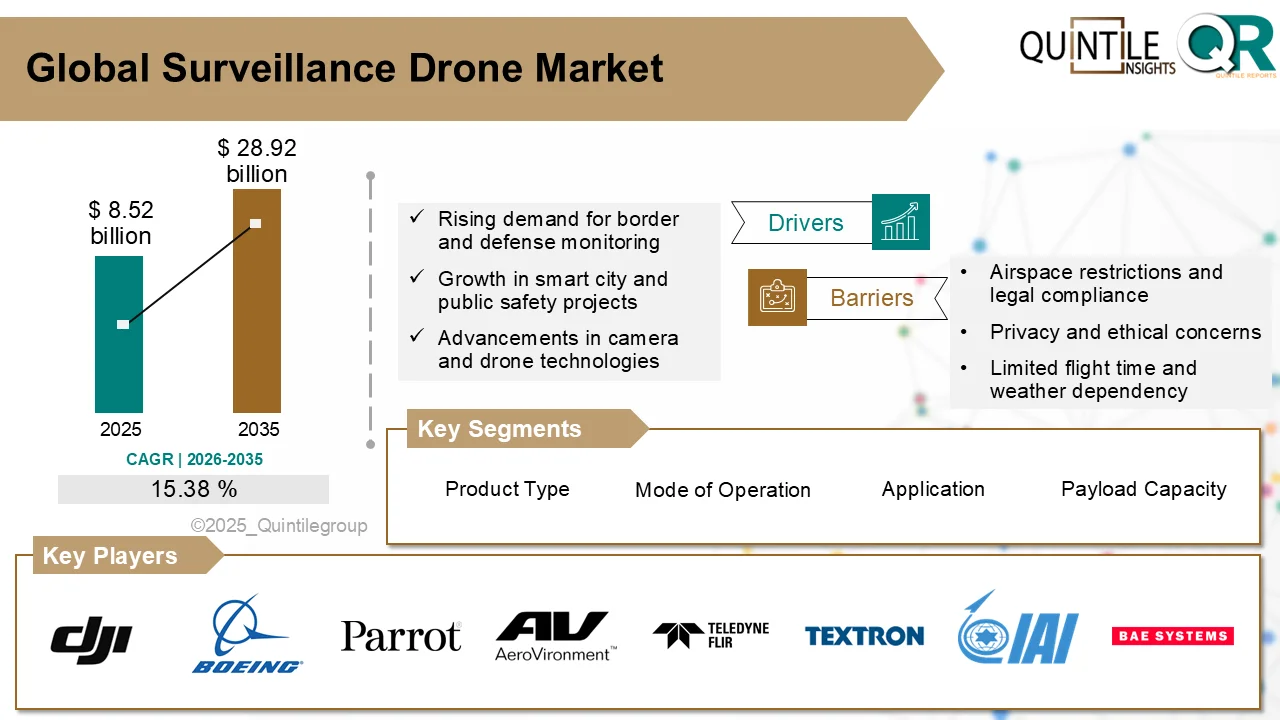
The global Surveillance Drone Market is experiencing rapid growth, driven by increasing security concerns, technological advancements, and expanding commercial applications. Valued at USD 8.52 billion in 2025, the market is projected to reach USD 28.92 billion by 2035, growing at a CAGR of 15.38% during the forecast period (2026–2035).

Introduction to the Surveillance Drone Market

Surveillance drones, also known as unmanned aerial vehicles (UAVs), are transforming how governments and businesses monitor environments, gather intelligence, and ensure safety. Equipped with advanced technologies such as AI-powered analytics, high-resolution cameras, thermal imaging, and LiDAR, these drones provide real-time data and actionable insights.

Their growing adoption across defense, law enforcement, infrastructure, and commercial sectors is fueling market expansion globally.

Download Free Sample PDF of the Report : https://www.quintilereports.com/request-sample/1280-surveillance-drone-market/

Market Drivers Accelerating Growth

1. Rising Global Security Concerns

Increasing threats related to terrorism, border security, and illegal activities are pushing governments to invest in advanced drone surveillance systems for enhanced monitoring and rapid response.

2. Expansion of Commercial Applications

Industries such as construction, agriculture, oil & gas, and logistics are adopting drone monitoring systems for:

  • Site inspection
  • Asset tracking
  • Environmental monitoring
  • Traffic and crowd surveillance

3. Technological Advancements in UAVs

Innovations in:

  • Artificial Intelligence (AI)
  • Machine Learning (ML)
  • Autonomous navigation
  • Real-time analytics

are making drones smarter, more efficient, and highly reliable.

Market Restraints and Challenges

Regulatory Barriers

Strict regulations regarding airspace usage and drone operations limit widespread adoption.

Privacy and Security Concerns

The use of surveillance drones raises concerns about data privacy, misuse, and cybersecurity risks.

High Initial Investment

Advanced drones with AI and sensor integration require significant upfront costs, restricting adoption among smaller organizations.

Latest Blog : https://www.researcheditorial.com/news/magnetic-induction-heating-device-market/

Key Opportunities in the Market

  • Growth of smart city projects
  • Increasing use in disaster management and emergency response
  • Adoption of 5G-enabled drone communication
  • Rising demand for autonomous and swarm drone technologies

Market Segmentation Analysis

By Type

  • Fixed-Wing Drones
  • Rotary-Wing Drones
  • Hybrid Drones

By Application

  • Defense & Military
  • Homeland Security
  • Commercial Surveillance
  • Environmental Monitoring

By End-User

  • Government Agencies
  • Commercial Enterprises
  • Others

LinkedIn Article : https://www.linkedin.com/pulse/surveillance-drone-market-growth-forecast-20262035-cagr-kirti-narayan-cdwzc

Regional Analysis

North America

Leads the market due to strong defense spending, advanced technology, and presence of key players.

Europe

Growing adoption in border control, public safety, and infrastructure monitoring.

Asia-Pacific

Fastest-growing region driven by rising investments in countries like China and India, along with rapid urbanization and security needs.

Competitive Landscape

The Surveillance Drone Market is highly competitive, with companies focusing on:

  • Product innovation
  • Strategic partnerships
  • AI integration
  • Expansion into emerging markets

Key players are investing heavily in R&D to develop next-generation surveillance drones.

Future Trends in the Surveillance Drone Market

  • Integration of 5G technology for real-time communication
  • Growth of AI-powered autonomous drones
  • Use of cloud-based analytics platforms
  • Expansion in smart city and infrastructure projects

Conclusion

The Surveillance Drone Market is set for substantial growth, with increasing adoption across defense and commercial sectors. As technology continues to evolve, drones will play a critical role in shaping the future of surveillance, security, and data intelligence.

Businesses that invest early in advanced UAV technologies and adapt to regulatory frameworks will gain a competitive edge in this rapidly expanding market.

Frequently Asked Questions (FAQs)

Q1. What is the growth rate of the Surveillance Drone Market?

The market is expected to grow at a CAGR of 15.38% from 2026 to 2035.

Q2. What is the market size by 2035?

It is projected to reach USD 28.92 billion by 2035.

Q3. What are the key applications of surveillance drones?

Defense, border security, infrastructure monitoring, agriculture, and disaster management.

Q4. Which region dominates the market?

North America currently leads, while Asia-Pacific is the fastest-growing region.

Exit mobile version