


Introduction
The global manufacturing industry is undergoing a massive transformation fueled by automation, artificial intelligence (AI), and robotics. Among the technologies driving this revolution, bin picking systems have emerged as a game-changing solution. These robotic systems can automatically pick and handle objects from bins or containers, even when they are randomly placed, enabling manufacturers to automate tasks that were previously labor-intensive.
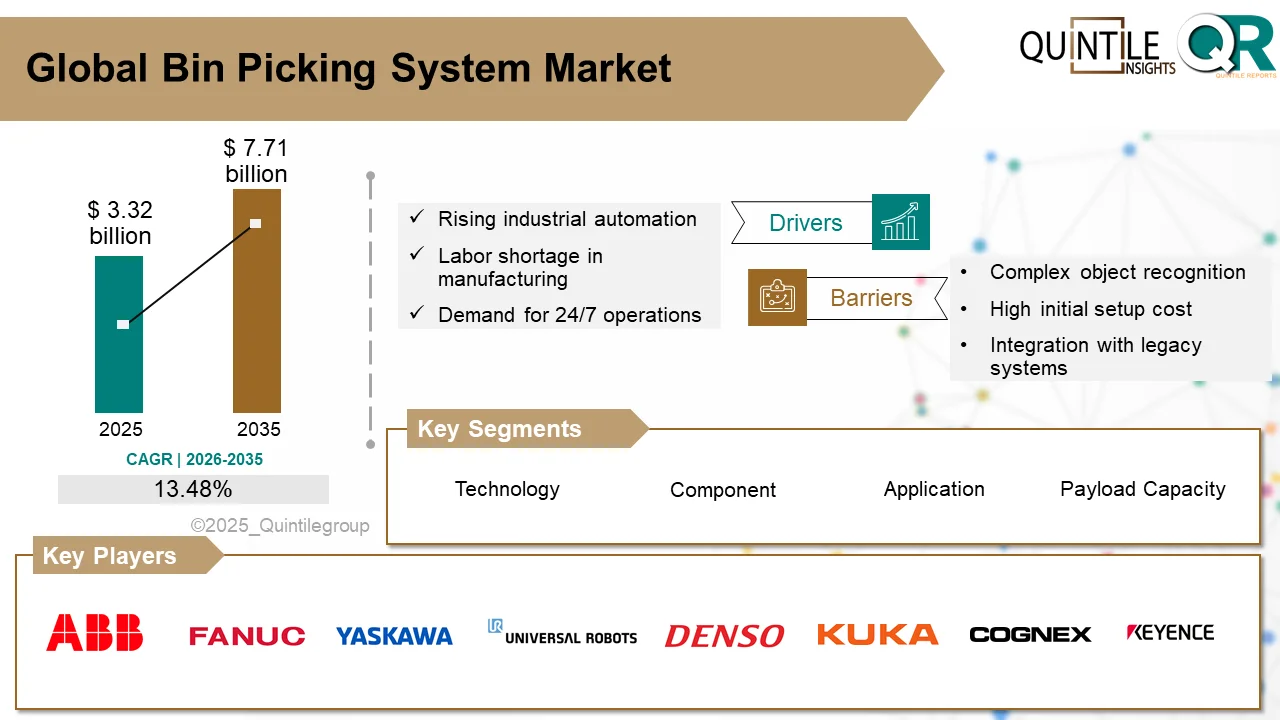
According to recent research, the Global Bin Picking System Market was valued at USD 3.32 billion in 2025 and is projected to reach USD 7.71 billion by 2035, growing at a robust CAGR of 13.48% during the forecast period. This remarkable growth reflects the rising adoption of smart factories, AI-driven robotics, and industrial automation across the globe.
In this comprehensive blog, we explore:
- What bin picking systems are
- Key drivers of market growth
- Industry applications
- Regional insights
- Market trends
- Challenges and opportunities
- Future outlook
Request a Complimentary Sample Report Before Purchase to evaluate detailed segmentation and regional outlook : https://www.quintilereports.com/request-sample/1222-bin-picking-system-market/
What Are Bin Picking Systems?
A bin picking system is an advanced automation technology that allows robots to pick objects from bins, boxes, or containers without human intervention.
How They Work
Traditional robots require objects to be pre-arranged in fixed positions. Bin picking systems eliminate this limitation using 3D vision, AI, machine learning, and sensors to detect the shape, orientation, and position of objects. The system then guides a robotic arm to pick and place objects with high precision.
Core Components of a Bin Picking System:
- Industrial Robotic Arms – For automated handling and placement
- 3D Vision Cameras – To capture the position and orientation of objects
- AI & Machine Learning Algorithms – For decision-making and adaptability
- Advanced Sensors – To improve accuracy and safety
With these technologies, bin picking robots can operate in unstructured environments, making them highly versatile for manufacturing, logistics, and warehouse applications.
Why the Bin Picking System Market Is Expanding Rapidly
1. Surge in Industrial Automation
Industries are increasingly investing in automation to enhance productivity, reduce labor costs, and improve precision. Bin picking systems are central to automated assembly lines, material handling, and logistics operations.
Benefits of Automation with Bin Picking Systems:
- Reduced operational costs
- Higher production efficiency
- Improved accuracy and consistency
- Enhanced workplace safety
- Minimized human errors
2. Labor Shortages
Many manufacturing sectors face labor shortages and high employee turnover. Bin picking robots can operate continuously without fatigue, handling repetitive tasks that would otherwise require manual labor.
3. AI and Machine Vision Advancements
Modern bin picking systems integrate AI algorithms, deep learning, and advanced 3D vision to recognize complex shapes, handle cluttered bins, and improve picking accuracy over time. This evolution makes these systems more reliable and cost-effective.
4. Smart Factory Integration
Bin picking systems are becoming a core component of smart factories, where robots communicate with conveyor systems, automated guided vehicles (AGVs), and warehouse management software to optimize production workflows.
Key Industry Applications
Automotive Manufacturing
The automotive industry is one of the largest adopters of bin picking technology. Robots handle components like metal parts, screws, and assembly materials, enabling high-volume production with minimal human intervention.
Electronics Production
In electronics manufacturing, bin picking systems automate the handling of small, delicate components like microchips, connectors, and circuit boards. Precision and accuracy are critical, making robotics indispensable.
Logistics and Warehousing
The boom in e-commerce and automated warehouses has increased demand for bin picking systems. Robots now assist with:
- Sorting products
- Picking items for orders
- Packaging and distribution
This accelerates fulfillment and reduces errors in high-volume operations.
Consumer Goods Manufacturing
From packaging to assembly, bin picking systems streamline operations in food, beverage, and other consumer goods industries, enabling faster production and reduced manual labor.
Latest Blog : https://www.researcheditorial.com/news/cbd-extraction-equipment-market/
Regional Market Insights
North America
North America holds a significant share of the bin picking system market. Advanced manufacturing infrastructure, high automation adoption, and presence of leading robotics companies contribute to market growth in the U.S. and Canada.
Europe
Europe is another major market, with Germany, France, and Italy leading industrial automation initiatives. The region benefits from government support for digital manufacturing and Industry 4.0 projects.
Asia-Pacific
The fastest-growing market is Asia-Pacific, driven by:
- Rapid industrialization
- Expanding automotive, electronics, and logistics sectors
- Significant robotics investments in China, Japan, South Korea, and India
Latin America and Middle East & Africa
These regions are gradually modernizing their manufacturing infrastructure, creating opportunities for bin picking system adoption.
Emerging Market Trends
AI-Enhanced Robotics
Artificial intelligence is improving bin picking efficiency. Robots learn from past operations, enhancing accuracy and decision-making.
Collaborative Robots (Cobots)
Cobots can safely work alongside humans, combining human flexibility with robotic precision. This trend is growing in small and medium-sized factories.
Integration with Smart Factories
Bin picking systems are increasingly connected with other automated systems, supporting real-time monitoring, predictive maintenance, and workflow optimization.
E-commerce and Logistics Boom
Robotic picking systems are being adopted by warehouses and fulfillment centers to keep up with rising e-commerce demand, particularly for fast delivery.
Challenges Facing the Market
- High Initial Investment: Advanced robotics, AI software, and integration costs can be prohibitive for smaller manufacturers.
- Technical Complexity: Systems require calibration, programming, and integration expertise.
- Integration with Legacy Systems: Older production lines may require modification to accommodate bin picking robots.
Future Outlook and Opportunities
The future of bin picking systems looks promising. Emerging technologies such as deep learning, cloud robotics, and advanced vision systems will further improve capabilities.
Potential new applications include:
- Food and beverage processing
- Pharmaceutical manufacturing
- Recycling and waste management
- Healthcare supply chain automation
Companies investing in these systems today will be better positioned to compete in the Industry 4.0 era.
Conclusion
The Global Bin Picking System Market is projected to grow from USD 3.32 billion in 2025 to USD 7.71 billion by 2035, driven by AI, robotics, and industrial automation.
Bin picking systems enhance efficiency, accuracy, and flexibility, enabling manufacturers to meet increasing demand while reducing labor costs.
Adopting these technologies now can provide a significant competitive advantage in the modern manufacturing landscape.
💡 Want to explore more? Check out my full LinkedIn article on the Bin Picking System Market for detailed insights, growth forecasts, and emerging trends in industrial automation.
Stay updated on AI, robotics, and smart manufacturing by following our blog for the latest industry insights.
Frequently Asked Questions (FAQ) – Bin Picking System Market
Q1: What is a bin picking system?
A: A bin picking system is an AI-powered robotic automation solution that identifies, picks, and handles objects randomly placed in bins, containers, or boxes. It combines 3D vision, machine learning, and robotic arms to automate repetitive manufacturing and warehouse tasks.
Q2: Why is the bin picking system market growing?
A: The market is expanding due to rising industrial automation, labor shortages, advances in AI and machine vision, and smart factory integration. The global market was valued at $3.32 billion in 2025 and is projected to reach $7.71 billion by 2035, growing at a CAGR of 13.48%.
Q3: Which industries use bin picking systems?
A: Key industries include:
- Automotive Manufacturing – Handling parts and assembly components
- Electronics – Sorting and assembling small electronic components
- Logistics & Warehousing – Automated order fulfillment and product sorting
- Consumer Goods Manufacturing – Packaging, sorting, and assembly operations
Q4: What technologies are used in bin picking systems?
A: Bin picking systems use:
- Robotic arms for automated handling
- 3D vision cameras for object detection
- AI and machine learning for decision-making
- Advanced sensors for accuracy and safety
Q5: Which regions are driving market growth?
A: North America and Europe lead in adoption due to advanced manufacturing infrastructure, while Asia-Pacific is the fastest-growing region, driven by industrial expansion in China, Japan, South Korea, and India.
Q6: What are the challenges in adopting bin picking systems?
A: Challenges include high initial investment, technical complexity, and integration with legacy production systems. However, technological advancements and decreasing costs are making adoption easier.
Q7: What is the future outlook for the bin picking system market?
A: The future is promising, with collaborative robots (cobots), deep learning, and advanced vision systems expanding applications into new industries like pharmaceuticals, food processing, recycling, and healthcare supply chains.