
Process Chillers Market Outlook: Why Industrial Cooling Is Becoming a Strategic Priority

Introduction

The Process Chillers Market is witnessing strong growth as industries increasingly depend on efficient and reliable cooling systems to maintain operational stability and product quality.

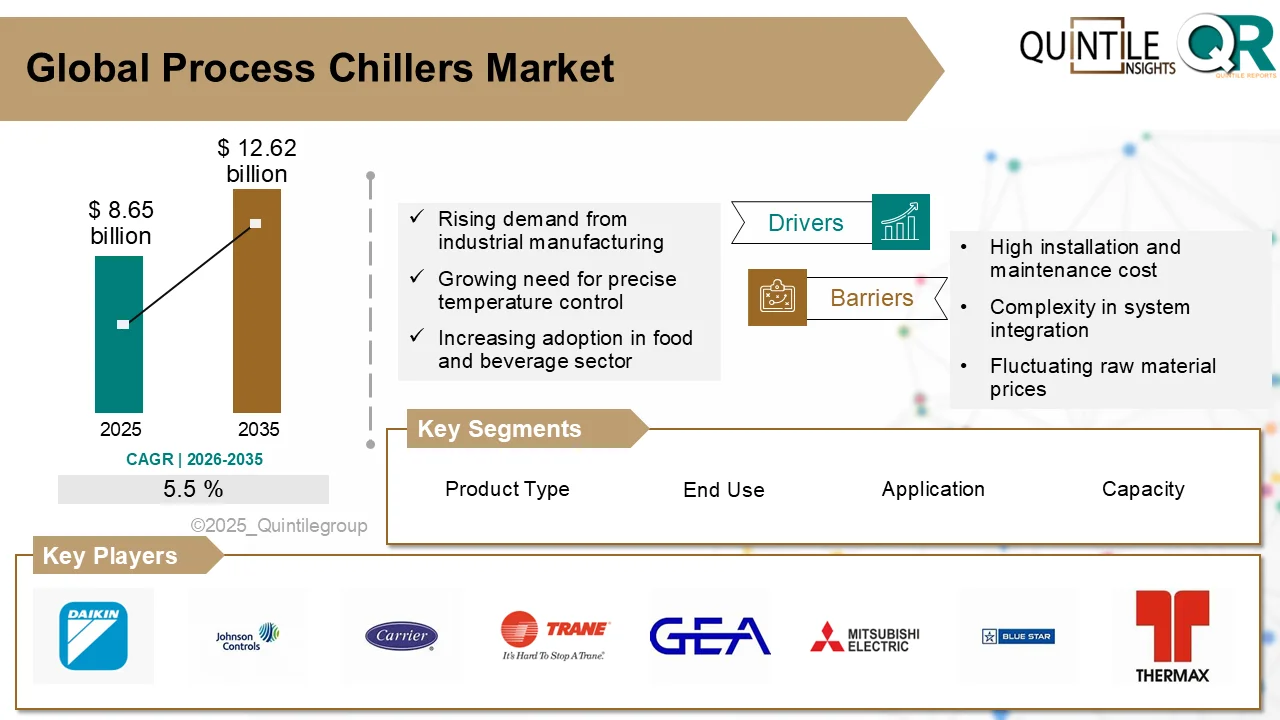
The market was valued at USD 8.65 billion in 2025 and is projected to reach USD 12.62 billion by 2035, growing at a CAGR of 5.5%.

Download a Free Sample Report to explore key insights and market data trends : https://www.quintilereports.com/request-sample/1286-process-chillers-market/

What Are Process Chillers?

Process chillers are specialized cooling systems designed to remove heat from industrial processes, ensuring temperature consistency, equipment safety, and production efficiency.

They are widely used in:

  • Pharmaceuticals
  • Food & Beverage
  • Plastics Manufacturing
  • Chemical Processing
  • HVAC Systems

Key Market Drivers

🔹 Industrial Automation Growth

Smart factories and Industry 4.0 trends are driving demand for advanced cooling systems.

🔹 Rising Demand for Energy Efficiency

Companies are focusing on reducing energy consumption and operational costs.

🔹 Expanding Manufacturing Sector

Global industrial expansion is boosting demand for process chillers.

🔹 Environmental Regulations

Strict policies are encouraging the adoption of eco-friendly refrigerants.

Market Trends

  • Smart chillers with IoT integration
  • Shift toward sustainable cooling solutions
  • Energy-efficient technologies
  • Integration with renewable energy

Regional Insights

  • North America: Advanced infrastructure and high adoption
  • Europe: Strong sustainability regulations
  • Asia-Pacific: Fastest-growing region
  • Rest of the World: Emerging opportunities

Latest Blog : https://www.researcheditorial.com/news/railway-hvac-market/

Market Segmentation

By Type:

  • Air-Cooled
  • Water-Cooled
  • Evaporative

By End-User:

  • Pharmaceuticals
  • Food & Beverage
  • Plastics
  • HVAC
  • Chemicals

By Capacity:

  • Small
  • Medium
  • Large

Key Players

  • Trane Technologies
  • Carrier Global Corporation
  • Daikin Industries Ltd.
  • Johnson Controls
  • Mitsubishi Electric
  • Hitachi

Challenges

  • High initial investment
  • Energy consumption issues
  • Regulatory compliance
  • Supply chain disruptions

Future Outlook

The future of the Process Chillers Market is driven by smart technologies, sustainability, and automation. Companies adopting advanced cooling systems will gain a competitive edge.

Key Features of the Report

  • Comprehensive market coverage
  • Growth trends and forecasts
  • Competitive landscape analysis
  • Sustainability insights

Key Reasons to Acquire the Report

✔ Comprehensive Analysis (2017–2035)

Detailed historical and future insights

✔ Growth Drivers & Opportunities

Covers automation, sustainability, and industrial growth

✔ Porter’s Five Forces

Strategic competitive analysis

✔ Deep Segmentation

Identifies high-growth opportunities

Access the full Process Chillers Market report and stay ahead in the industry : https://www.quintilereports.com/buy-now/?id=1286-process-chillers-market&license_type=su

Conclusion

The Process Chillers Market is evolving rapidly with increasing demand for efficient, smart, and sustainable cooling solutions. Businesses investing in advanced technologies today will be better positioned for future growth.

Read This Article on LinkedIn

Want a more insight-driven and discussion-focused version of this analysis?

👉 Read the LinkedIn article here: https://www.linkedin.com/pulse/process-chillers-market-outlook-2035-backbone-smart-cooling-narayan-boxyf

Frequently Asked Questions (FAQs)

1. What is the current size of the Process Chillers Market?

The Process Chillers Market was valued at USD 8.65 billion in 2025 and is expected to grow steadily over the forecast period.

2. What is the expected growth rate of the market?

The market is projected to grow at a CAGR of 5.5% from 2026 to 2035.

3. What will be the market size by 2035?

The market is forecast to reach approximately USD 12.62 billion by 2035.

4. What are process chillers used for?

Process chillers are used to remove heat from industrial processes, ensuring consistent temperature control and efficient operations.

5. Which industries use process chillers the most?

Major industries include:

  • Pharmaceuticals
  • Food & Beverage
  • Plastics Manufacturing
  • Chemical Processing
  • HVAC Systems

6. What are the main types of process chillers?

The primary types include:

  • Air-cooled chillers
  • Water-cooled chillers
  • Evaporative chillers

7. What factors are driving market growth?

Key drivers include:

  • Industrial automation
  • Demand for energy-efficient systems
  • Expansion of manufacturing sectors
  • Environmental regulations

8. Which region is growing the fastest?

Asia-Pacific is the fastest-growing region due to rapid industrialization and infrastructure development.

9. What challenges does the market face?

Some major challenges include:

  • High initial investment costs
  • Energy consumption concerns
  • Regulatory compliance
  • Supply chain issues

10. What is the future of the Process Chillers Market?

The market will focus on smart, energy-efficient, and eco-friendly cooling systems, with increasing adoption of IoT and sustainable technologies.
Geothermal Heat Pumps Market to Reach $828M by 2035: Driving the Clean Energy Revolution

Introduction

The global clean energy transition is accelerating, and geothermal heat pumps (GHPs) are emerging as a critical solution for efficient heating and cooling.

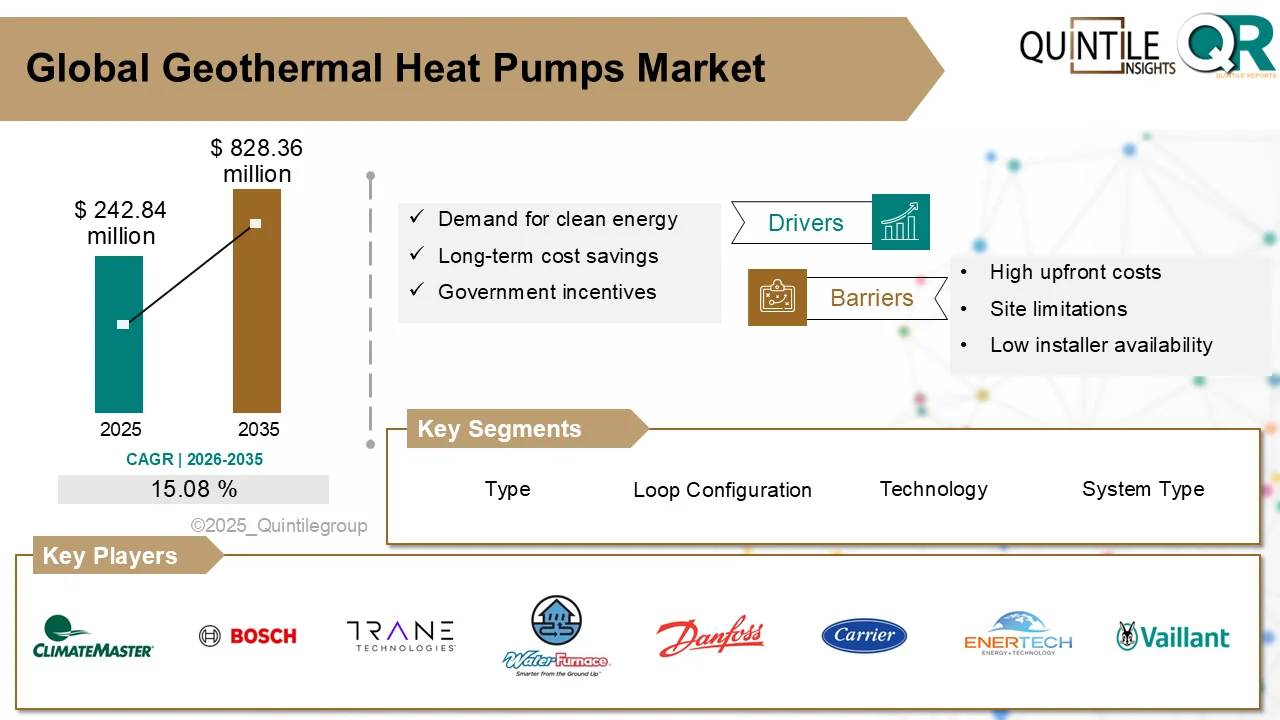
Valued at USD 242.84 million in 2025, the geothermal heat pumps market is projected to reach USD 828.36 million by 2035, expanding at a robust CAGR of 15.08%.

GHPs use the earth’s stable underground temperature to regulate indoor climate, offering both cost savings and sustainability benefits over conventional HVAC systems.

Download Free Sample PDF of the Report https://www.quintilereports.com/request-sample/1229-geothermal-heat-pumps-market/

Why Geothermal Heat Pumps Are Gaining Traction

  • High Energy Efficiency: Up to 4x more efficient than traditional HVAC.
  • Long-Term Cost Savings: Lower energy bills and reduced operational costs.
  • Eco-Friendly: Supports net-zero and ESG goals.
  • Durable Systems: Lifespan of 20–50 years with minimal maintenance.

Key Drivers of Market Growth

1. Rising Energy Costs
Fluctuating electricity and fuel prices are pushing consumers and businesses toward energy-efficient alternatives.

2. Government Incentives
Tax credits, subsidies, and renewable energy mandates are accelerating GHP adoption.

3. Technological Advancements
Innovations in drilling, hybrid systems, and smart controls are making GHPs more accessible.

4. Sustainability Goals
Green building initiatives and environmental regulations are boosting demand for eco-friendly heating solutions.

Latest Blog : https://www.researcheditorial.com/news/solar-dryer-market/

Emerging Market Trends

  • Smart Home Integration: IoT-enabled geothermal systems allow real-time monitoring and optimization.
  • Hybrid HVAC Systems: Geothermal combined with conventional HVAC for cost-effective solutions.
  • Commercial Adoption: Hospitals, offices, and retail spaces increasingly deploying GHPs.
  • Retrofitting Projects: Upgrading existing buildings for improved energy efficiency.

Regional Insights

  • North America: Market leader due to infrastructure, awareness, and incentives.
  • Europe: Growth driven by stringent environmental regulations and sustainability targets.
  • Asia-Pacific: Fastest-growing region with rising urbanization and energy demand.

Get Discount On The Purchase Of This Report https://www.quintilereports.com/request-discount/1229-geothermal-heat-pumps-market/

Challenges Facing the Market

  • High upfront installation costs
  • Limited awareness in developing regions
  • Space and installation constraints in urban areas

Despite these challenges, long-term savings and environmental benefits continue to drive adoption.

Future Outlook

By 2035, the market is expected to reach USD 828.36 million, powered by:

  • Widespread adoption of renewable energy
  • Technological innovation
  • Government support
  • Growing environmental awareness

Geothermal heat pumps are becoming a mainstream solution in the clean energy transition.

Conclusion

The geothermal heat pumps market is poised for exponential growth over the next decade. Investors, building developers, and policymakers have an opportunity to leverage this efficient, sustainable, and cost-effective technology for long-term gains.

Frequently Asked Questions (FAQ)

Q1: What are geothermal heat pumps?
A: Geothermal heat pumps (GHPs) are energy-efficient systems that use the earth’s stable underground temperature to heat and cool buildings. They transfer heat instead of generating it, making them far more efficient than traditional HVAC systems.

Q2: How big is the geothermal heat pumps market?
A: The global geothermal heat pumps market was valued at USD 242.84 million in 2025 and is projected to reach USD 828.36 million by 2035, growing at a CAGR of 15.08%.

Q3: What are the key benefits of geothermal heat pumps?
A: Major benefits include:

  • Up to 4x higher energy efficiency
  • Lower operating costs
  • Reduced greenhouse gas emissions
  • Long system lifespan (20–50 years)
  • Reliable performance in all climates

Q4: What factors are driving market growth?
A: The market is growing due to rising energy costs, government incentives, sustainability initiatives, technological advancements, and increasing adoption in residential and commercial buildings.

Q5: Which regions are leading the geothermal heat pumps market?
A:

  • North America: Market leader with strong incentives and awareness.
  • Europe: Growth fueled by strict environmental regulations.
  • Asia-Pacific: Fastest-growing region due to urbanization and rising energy demand.

Q6: What challenges does the market face?
A: Challenges include high initial installation costs, limited awareness in some regions, and space or installation constraints in urban areas.

Q7: What is the future outlook for geothermal heat pumps?
A: By 2035, the market is expected to reach USD 828.36 million, driven by renewable energy adoption, technological innovation, supportive policies, and increased awareness of sustainability.

Exit mobile version