


Introduction
The Superconductor Motors Market is emerging as one of the most advanced and disruptive segments in the global electric propulsion and energy efficiency landscape. These motors utilize superconducting materials that allow electricity to flow with near-zero resistance when cooled below a critical temperature.
As industries worldwide move toward electrification, decarbonization, and high-efficiency systems, superconductor motors are gaining strong attention across aerospace, marine propulsion, industrial automation, and power generation sectors.
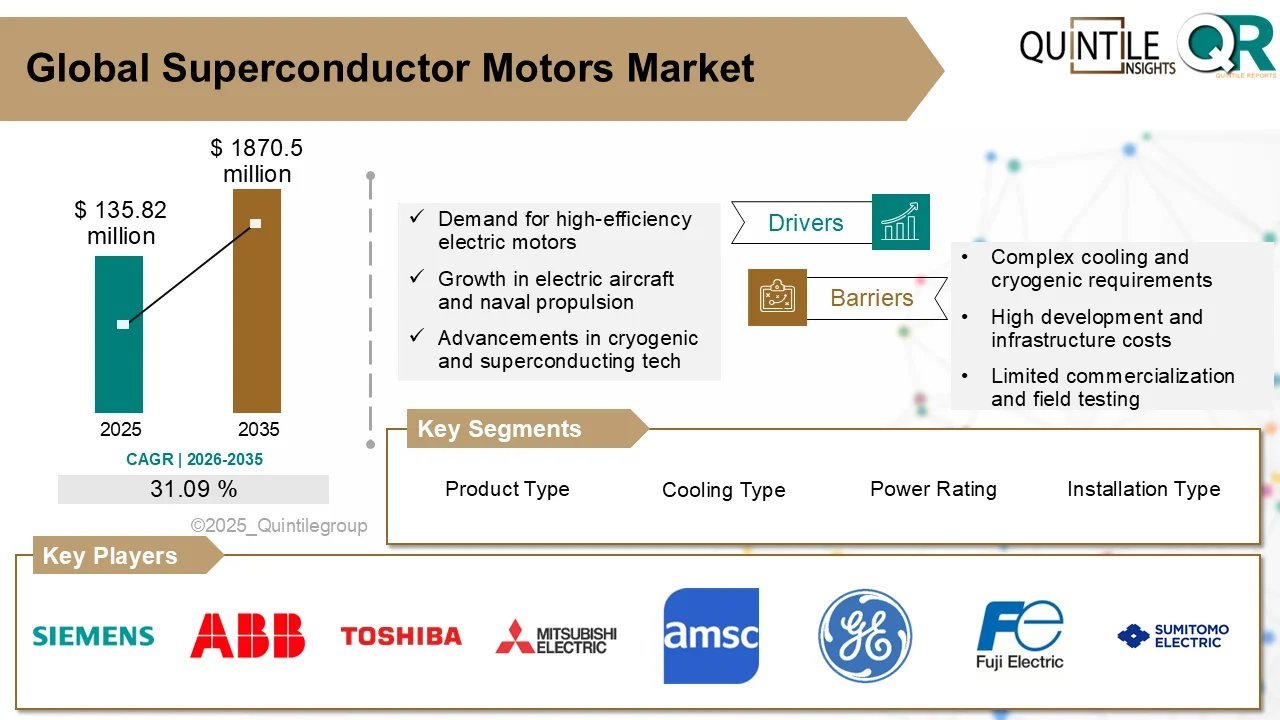
Between 2026 and 2035, the market is expected to experience significant expansion, supported by technological innovation, government funding, and increasing demand for high-performance electric systems.
DOWNLOAD PDF BROCHURE : https://www.quintilereports.com/request-sample/1262-superconductor-motors-market/
What Are Superconductor Motors?
Superconductor motors are advanced electric machines that use superconducting wires or materials in their windings. When cooled using cryogenic systems, these materials exhibit zero electrical resistance, enabling:
- Extremely high efficiency
- Higher torque density
- Reduced energy loss
- Compact motor size
- Improved performance under heavy load
These features make them ideal for applications where traditional motors struggle due to size, heat, or energy loss limitations.
Superconductor Motors Market Overview
The global Superconductor Motors Market is transitioning from research-based development to early-stage commercialization. While still an emerging technology, it is rapidly gaining traction in high-value industries.
Key characteristics of the market include:
- Strong R&D investments
- High dependence on cryogenic technologies
- Early adoption in aerospace and defense sectors
- Increasing focus on energy-efficient propulsion systems
- Growing interest in HTS (High-Temperature Superconductors)
Market Growth Drivers
1. Rising Demand for Energy Efficiency
Industries are under pressure to reduce energy consumption and operational costs. Superconductor motors offer significantly higher efficiency than conventional electric motors, making them attractive for long-term sustainability goals.
2. Electrification of Transportation Systems
The shift toward electric transportation is a major growth driver. Superconductor motors are being explored in:
- Electric aircraft
- Electric ships and submarines
- High-speed rail systems
- Advanced EV propulsion systems
Their high torque density makes them suitable for next-generation mobility solutions.
3. Advancements in High-Temperature Superconductors (HTS)
Historically, superconductors required extremely low temperatures, limiting real-world applications. However, HTS materials are reducing cooling requirements and improving feasibility.
This advancement is helping the market move closer to commercialization.
4. Government & Defense Funding
Governments in North America, Europe, and Asia Pacific are heavily investing in:
- Clean energy technologies
- Aerospace propulsion systems
- Defense electrification programs
- Advanced research initiatives
These investments are accelerating prototype development and pilot projects.
5. Demand for Compact High-Power Systems
Industries such as aerospace and marine engineering require motors that are:
- Lightweight
- Compact
- High-powered
- Highly efficient
Superconductor motors meet these requirements better than conventional systems.
Latest Blog : https://www.researcheditorial.com/news/liquid-mushroom-market/
Market Restraints
Despite strong potential, several challenges slow down adoption:
1. High Cost of Materials
Superconducting wires and materials are expensive, increasing production costs.
2. Cryogenic Cooling Complexity
These motors require specialized cooling systems such as liquid helium or liquid nitrogen, which increases operational complexity.
3. Limited Commercial Deployment
Most applications are still in prototype or pilot stages, with limited large-scale commercialization.
4. Supply Chain Limitations
The supply of superconducting materials is concentrated among a small number of specialized manufacturers.
Regional Analysis
🇺🇸 North America
North America leads in R&D and defense applications. The United States is heavily investing in aerospace propulsion, electric aircraft, and advanced energy systems.
🇪🇺 Europe
Europe focuses on sustainability, renewable energy, and electrified transport systems. Countries like Germany, France, and the UK are actively funding clean energy motor technologies.
Asia Pacific
Asia Pacific is the fastest-growing region. Japan leads in real-world testing, especially in maglev trains and transport systems, while China and South Korea are investing heavily in manufacturing and defense applications.
Rest of the World
Regions such as Latin America, the Middle East, and Africa are in early stages of adoption, mainly focusing on research and pilot projects.
Market Segmentation
By Motor Type
- Synchronous Motors
- Induction Motors
- Homopolar Motors
- Brushless DC Motors
By Superconductor Type
- Low-Temperature Superconducting (LTS) Motors
- High-Temperature Superconducting (HTS) Motors
By Cooling Type
- Liquid Helium Cooling
- Liquid Nitrogen Cooling
- Cryocooler-Based Systems
By Power Rating
- Up to 1 MW
- 1–10 MW
- Above 10 MW
By Application
- Aerospace & Defense
- Marine Propulsion
- Industrial Machinery
- Power Generation
- Transportation
- Oil & Gas
- Utilities
LinkedIn Article : https://www.linkedin.com/pulse/superconductor-motors-market-20262035-growth-drivers-trends-narayan-5bk5c
Competitive Landscape
The market is moderately consolidated with major global players investing in research and prototype development:
- General Electric
- Siemens AG
- ABB Ltd.
- Mitsubishi Electric Corporation
- Toshiba Corporation
- Sumitomo Electric Industries
- American Superconductor Corporation (AMSC)
- Northrop Grumman Corporation
- Fuji Electric Co., Ltd.
- SuperOx
These companies are focusing on partnerships, innovation, and pilot deployments to strengthen their market position.
Future Outlook (2026–2035)
The Superconductor Motors Market is expected to evolve significantly over the next decade. Key future trends include:
- Transition from R&D to pilot-scale commercialization
- Expansion in aerospace and marine propulsion applications
- Reduction in cooling system complexity
- Lower cost of HTS materials
- Increased adoption in Asia Pacific region
By 2035, superconductor motors are expected to play a critical role in next-generation energy-efficient propulsion systems.
Frequently Asked Questions (FAQ)
1. What is the Superconductor Motors Market?
It refers to the development and use of motors that operate using superconducting materials to achieve near-zero energy loss and high efficiency.
2. What is driving market growth?
Growth is driven by electrification trends, aerospace innovation, and increasing demand for energy-efficient systems.
3. Which industries use superconductor motors?
Aerospace, marine propulsion, transportation, industrial machinery, and power generation industries.
4. What are the key challenges?
High cost, cryogenic cooling requirements, and limited commercial adoption are major challenges.
5. Which region leads the market?
North America leads in R&D, while Asia Pacific is the fastest-growing region.
Final Thoughts
The Superconductor Motors Market represents a major leap forward in electric propulsion and energy efficiency technology. While still in its early stages, continuous advancements in superconducting materials and global electrification trends are expected to drive strong growth through 2035.
Companies investing early in this technology are likely to gain a significant competitive advantage in future high-performance energy systems.