Temperature Control Unit Market 2025–2035: Key Trends, Growth Drivers & Future Outlook
Temperature Control Units (TCUs) play an essential role in maintaining precise thermal conditions across a wide range of industrial operations. Whether it’s plastic molding, chemical processing, pharmaceutical production, food manufacturing, or high-precision machining — temperature consistency directly affects product quality, operational safety, and energy efficiency.
As industries continue shifting toward automation, smarter manufacturing techniques, and energy-efficient systems, the Temperature Control Unit Market is entering an important growth phase. This blog explores the major trends, drivers, opportunities, and future direction of the global TCU industry.
👉 Looking for the full Temperature Control Unit Market sample report?
Click here to Download the Sample
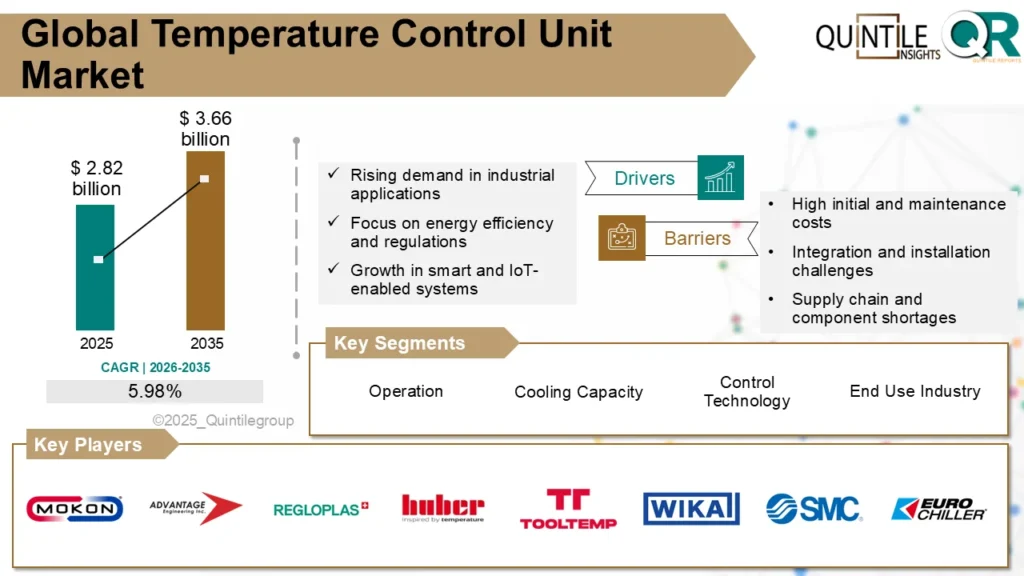
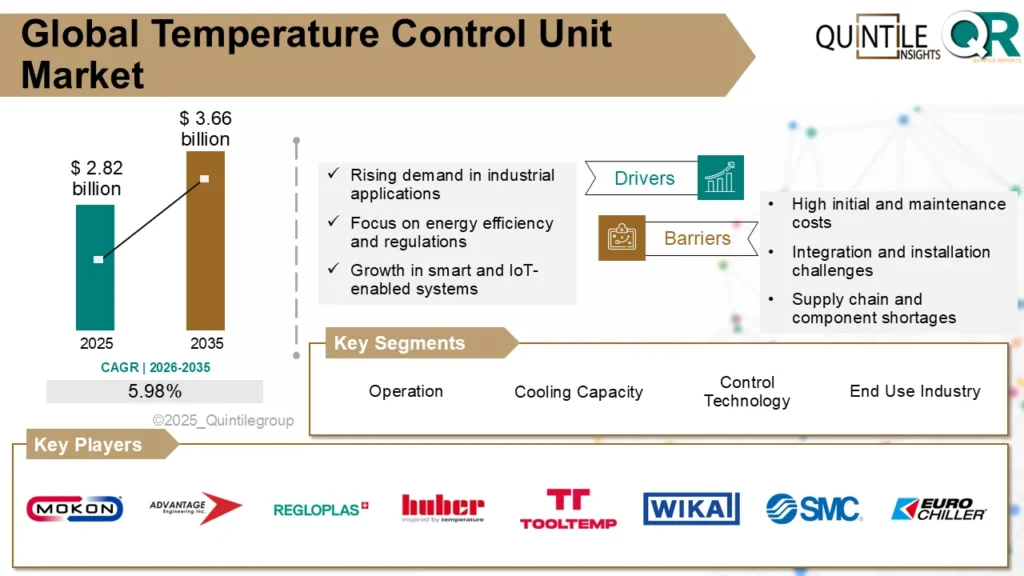
The Global Temperature Control Unit Market was estimated at USD 2.82 billion in 2025 and is projected to reach USD 3.66 billion by 2035, reflecting a robust CAGR of 5.98% over the forecast period from 2026 to 2035. The Temperature Control Unit market report offers a comprehensive and nuanced view of the industry, moving beyond conventional analysis. It provides a thorough examination of the markets dynamics, encompassing a detailed exploration of the factors propelling growth, such as evolving economic conditions, advancements in technology, shifts in regulatory policies, and changes in consumer behavior. Furthermore, the report discusses the projected Compound Annual Growth Rate (CAGR), providing stakeholders with a clear understanding of the market’s expected growth trajectory and offering data-driven insights into future market dynamics.
What is a Temperature Control Unit (TCU)?
A Temperature Control Unit is an industrial device designed to regulate and maintain a stable temperature during production processes. It uses heating or cooling mechanisms to ensure the correct thermal environment for machinery, molds, reactors, or production lines.
Common applications include:
- Plastics injection molding
- Pharmaceutical & biotech production
- Food & beverage processing
- Chemical reactors and blending operations
- Oil & gas pipelines
- Die casting, metalworking, and surface finishing
As industries demand more accuracy and efficiency, TCUs are becoming more advanced, automated, compact, and energy-optimized.
Market Outlook (2025–2035)
While exact numbers vary across research sources, analysts widely agree that the Temperature Control Unit Market is expected to grow steadily over the next decade.
Several factors contribute to this positive outlook:
- Rising use of automated production systems
- Increased adoption of smart manufacturing
- Need for stable thermal control in high-precision industries
- Growth in pharmaceutical and chemicals sectors
- Expansion of manufacturing units in Asia, South America, and Eastern Europe
The long-term outlook remains strong, with TCU manufacturers focusing on innovation, efficiency, and sustainability.
💰 Want an exclusive discount on this report?
Click here to get your discount
Key Growth Drivers in the Temperature Control Unit Market
1. Industrial Automation & Smart Factories
Industries worldwide are shifting toward fully automated and sensor-driven production systems. TCUs today are integrated with:
- IoT-based monitoring
- Remote operation systems
- Predictive maintenance algorithms
- Smart alarms and safety controls
This enhances productivity and minimizes equipment downtime.
2. Demand for Energy-Efficient Solutions
Energy cost reduction is a top priority for manufacturing companies. Modern TCUs are designed to:
- Reduce power consumption
- Optimize heating/cooling cycles
- Use eco-friendly refrigerants
- Improve thermal efficiency
Manufacturers with sustainable designs are gaining strong market traction.
3. Temperature-Critical Industries Are Expanding
Sectors that depend heavily on heat control—pharma, chemicals, food processing, semiconductors, and plastics—are experiencing rapid growth.
More production means higher demand for reliable TCUs.
4. Tightening Quality & Safety Regulations
Government and international bodies are enforcing strict controls over temperature-sensitive manufacturing environments. This increases the adoption of:
- Precision temperature controllers
- High-accuracy sensors
- Automated compliance monitoring
Industries aiming to meet regulatory standards increasingly invest in advanced TCUs.
Market Segmentation Overview
To understand the market better, here’s how TCUs are typically segmented:
Key Players Operating in the Temperature Control Unit Market are as follows:
- Mokon
- Regloplas AG
- Advantage Engineering, Inc.
- Huber Kaltemaschinenbau AG
- Tool-Temp AG
- SMC Corporation
Based on Operation, the Temperature Control Unit market is segmented into:
- Automatic
- Semi-Automatic
- Manual
Based on Cooling Capacity, the Temperature Control Unit market is segmented into:
- Up to 40 kW
- 4080 kW
- Above 80 kW
Based on End Use Industry, the Temperature Control Unit market is segmented into:
- Plastics
- Food & Beverage
- Pharmaceuticals
- Chemicals
- Automotive
- Oil & Gas
- Printing
- Die Casting
- Others
Based on Temperature Range, the Temperature Control Unit market is segmented into:
- Up to 100C
- 100200C
- Above 200C
Based on Pump Type, the Temperature Control Unit market is segmented into:
- Centrifugal
- Gear
- Screw
- Others
Challenges in the Temperature Control Unit Market
Despite growth, industries still face several challenges:
1. High Upfront Cost
Advanced TCUs with smart sensors and automation systems are more expensive, which may limit adoption among small manufacturers.
2. Skilled Workforce Requirements
Operating and maintaining TCUs requires technical knowledge, especially for advanced digital units.
3. Maintenance & Downtime Risks
If not monitored properly, temperature fluctuations can affect product quality and lead to operational delays.
4. Customization Needs
Different industries require different temperature ranges, coatings, materials, and control systems — making customization essential but costly.
Emerging Trends: What to Expect Next
1. IoT-Enabled & Connected TCUs
Smart TCUs with real-time monitoring and cloud analytics will become standard in modern factories.
2. Miniaturized & Modular Units
Compact, plug-and-play units are increasingly preferred for space-constrained industries.
3. Eco-Friendly Refrigerants & Green Standards
Environmental regulations are pushing manufacturers toward zero-emission systems.
4. High-Precision Cooling for Electronics
As electronics and semiconductor industries expand, precise micro-cooling TCUs will gain popularity.
5. Custom-Designed TCUs for Niche Applications
Industries such as 3D printing, biotech labs, and specialty chemicals require tailor-made TCUs with advanced features.
Why This Market Matters for Investors & Manufacturers
- Steady global demand ensures long-term revenue.
- Increasing regulatory compliance makes TCUs essential equipment.
- Rising automation and smart manufacturing boosts advanced TCU adoption.
- Growth in pharma, chemicals, plastics, and electronics creates continuous industry need.
Businesses in these sectors can significantly benefit by upgrading to modern, efficient, data-driven temperature control systems.
Key Reasons to Acquire the Temperature Control Unit Market Research Report:
- This report offers a comprehensive analysis of the Temperature Control Unit market from 2017 to 2035, including market segments, current trends, estimations, and dynamics
- It also provides information on key drivers, restraints, and opportunities
- Porter’s five forces analysis is used to assess the potency of buyers and suppliers, helping stakeholders make profit-oriented business decisions and strengthen their supplier-buyer network
- The report includes an in-depth analysis of the Temperature Control Unit market segmentation to identify prevailing market opportunities
- Major countries in each region are mapped according to their revenue contribution to the global market
- Market player positioning is also analyzed to facilitate benchmarking and provide a clear understanding of the present position of the market players
- The report includes an analysis of the regional and global Temperature Control Unit market trends, key players, market segments, application areas, and market growth strategies
Conclusion
The Temperature Control Unit Market is entering a transformative period shaped by automation, energy efficiency, and industrial expansion. The next decade will see TCUs becoming smarter, more sustainable, more precise, and deeply integrated into digital manufacturing ecosystems.
Manufacturers that prioritize innovation—and industries that upgrade to modern TCUs—will be better positioned to improve product quality, reduce operational costs, and achieve regulatory compliance.
If your company operates in plastics, food processing, chemicals, pharma, or any temperature-sensitive field, modernizing your TCU systems is no longer optional — it’s a strategic advantage.